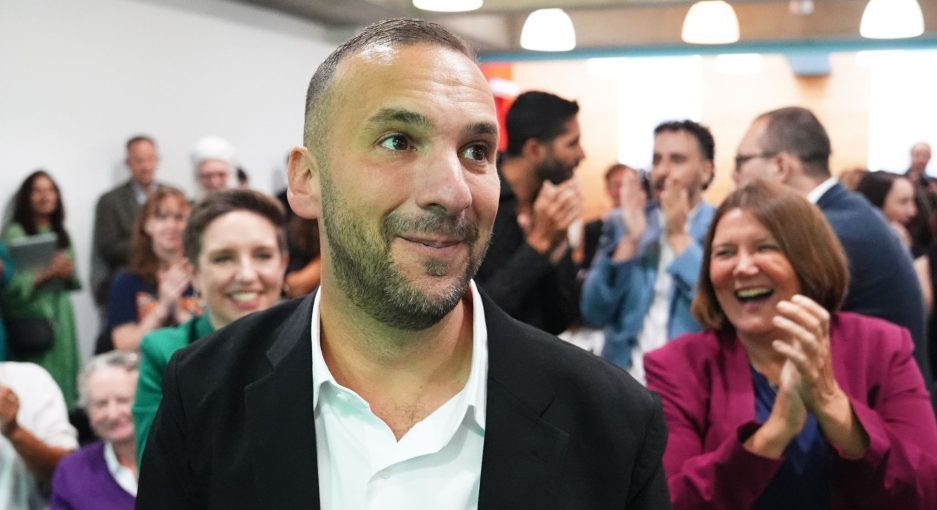
Priest in the Tempest.

It had everything, including the tempest. Apparently the seas – well, Humber – got so wild that codling were being hurled into the stadium. The roof of the ancient Main Stand almost collapsed, not just because of the massed excitement but because of the weight of the krill. The lad Mbeumo had to fiddle a flattie from under his shirt before taking *that pen*: hence the miss.

Ah yess, the Grimbo-jokes. The howling gale of back-handed compliments and faintly feeble headlines, from media owned by Southern Softies and/or far-flung moguls. ‘Town batter United!’ ‘Shoal of the Century! The analytical consensus that ‘Amorim is drowning not waving!’ Marvellous.

The truth is that Grimsby Town outplayed Manchester United, in the first half. They had a strong case for a third goal, before United gathered at all – ruled out: no VAR. Yes, absolutely true that in the monsoon, the Mariners did lose their composure. Have no doubt that the apparently unfeasibly calm David Artell would have been inwardly raging at the way in which possession was repeatedly thrown away, in the second period. But perhaps it’s forgivable that messrs Fernandes and Mbeumo – amongst other key introductions – *did* turn the thing around. They do, despite the awful mess United are in, have some quality.

Vernam’s outstanding team goal lit the proverbial fuse on a night when many of my favourite people were in the stands, belting out the home anthems. (Yess. Am Grimsby – despite now being not unfairly described by those in the borough as Plastic Taff. And yess, grandfather played for both teams. So this is all rather huge. I know those streets and those stands).

The ground is wonderfully (largely) from another age; as seen on TV. The staff *really are* all about embedding this club in the community, in a way that the majority of club-owning scheisters and stockbrokers simply don’t understand. They can ‘project their visions’ all they want. Blundell Park ain’t perfect (and neither are the Team Leaders) but something very real has always lurked there. Jason Stockwood does appear to know that corporatism is the death of sport and of truth itself. Grimsby are Grimsby: they do deserve this kind of night.

So forty-five minutes in dreamland, with McEachran – who has quality – strolling around, and Artell’s side looking shapely and intelligent. Control of the game. A goal that might have been disallowed for handball (possibly?) and then Gardner’s borderline effort ruled-out. United all over the place – not just being ‘out-battled,’ that wouldn’t do justice to Town.

Half-time comes and Amorim implements the necessary cull. Fredericson patently had to go but half the team must’ve been a-wondering. Including Onana. The rain turns biblical and we Town fans think this might be just what we need – an absolute lottery! But in truth, both because of the influx of talent and intent and Grimsby’s understandable wastefulness with the limited possession they have, Manchester get back in it. Maguire is always on that figure-of-fun/Major Leader interface but notably he brought it – commendable spirit, I mean – and the reds fans had something to shout about. Then those pens.

I generally turn penalties off; no matter what the occasion. I watched these. We could throw descriptors like biblical and epic and humbling and heart-warming in there. Even neutrals might be doing some of that. I’m not neutral. I, erm, kinda follow both teams.

My socials went mad. The coverage has gone mad; because it’s Town, because it’s United. If there’s a consensus it’s that despite being a man of intelligence, integrity and purpose, Amorim is closer to the brink than he was pre the Trial At Blundell Park. Even those with active brain cells are saying that despite the carnage the man inherited, he is unable to make anything work and has to be accountable for that. Plainly, he is. The rest just want rid, being unable to see any complexity in this.

I think there is complexity. Take the case of Artell. When he came in (and on multiple occasions since then) he has felt like fella who can talk a good game. But not necessarily one you would follow or utterly believe in. He’s currently turning that perception around – with the players and support. Town have a pattern of play and a level of confidence. United, despite the talk of tactical drive, have neither.

We might talk dangerously in the abstract about character. We might be critical of the Premier League side on that, both last night and in general: everyone from Mainoo to Diallo to Cunha, perhaps? Would you want them in the trenches; never mind on a wet Wednesday at Blundell Park? Town’s players, from the outstanding Pym to the hearty Green and Rodgers, knew they had to bring some grit and determination (as a certain Mr Hansen might have said) to the proceedings. Because MU have better footballers. Therefore (we) work like hell.

Coaching is surely blending? Finding deeply and fabulously different qualities in different individuals and blending them together, whilst (in the modern era) feeding in bucketloads of stats and tactical info and beliefs. Ideally you want players with inviolable spirit and confidence but life ain’t like that. So blend and build. Amorim has work to do. We can no longer be clear that he has the time or the oomph to do it.

But those pens. Ridiculous and also pret-ty maarvellous that a whole cluster of League Two players held their nerve and slotted… almost endlessly. When the universe was screaming for it to end. Their composure in that moment is not all down to Artell, of course. But let’s give the man some credit for patrolling it with such evenness. Like a priest in the tempest. Fish all around him.

Fernandes finds it.

We expected a biblical thrashing and got a biblical lashing. Liverpool was drenched, and so were we, in the usual psychotic drama of the fixture. Exbloodyzausting.

Trent made all the arguments for his transfer to Real. Hojlund powerfully reasserted his cruel, honest capacity to be ordinary. Fernandes finally found almost everything he’s lost for what – two seasons? Zirkzee came on and right at The Death overhit a wee pass to Maguire that got clumped over the bar with the net not so much yawning as black-holing. It was all soaked in sleet and glory and misery and yes, exhaustion. The players looked knackered, too.

Generality and gravity and meaning itself get swallowed-up in this most bile-full of games but let’s have a thrash at some streaky factoids. United deserved at least a point, after a performance of real grit and some quality – or at least organisation and heart. Liverpool had only occasional lung-bursting thrusts: markedly less control and, astonishingly given *all the trends,* practically zilch in the way of dominance. MacAllister should have scored, and maybe Gravenberg, in the first twenty, but United played with commendable composure around the inevitable surges. When Martinez thumped the visitors ahead, it felt kinda logical, in this sopping madness.

Liverpool’s response was more scattergun than Slot would have wanted. Sure they found themselves ahead but for longish periods there were no meaningful or threatening phases of play and Alexander-Arnold’s flank was a disaster area. The Outrageously Gifted One had a mare, almost from start to finish, leaving most of us nodding sagely at the thought of his upcoming role as unmolested God-Quarterback at Real.

Dalot was skinning him at will, on one occasion delivering a fabulous teasing cross that Amad either simply misread or could not, in the downpour, adjust himself for. Either way it looked like the striker – who was almost entirely absent from the fixture, despite being United’s most dangerous outlet for weeks – falls into the Can’t Head it for the Life of Him category. Alongside most contemporary forwards, you might say.

Fernandes has been an infuriatingly infuriated individual most of his life. After starting like a world-beater at United he has been playing well below capacity for aeons. The poor love looks infuriated by that… and referees… and by the inadequacies of his team-mates. His discipline has been ragged, as has his ability to thread passes that he knows Bruno F should be making in his sleep. Today he found most of the stuff that’s been missing. He was almost towering.

Amorim will be genuinely disappointed his lads couldn’t quite engineer a startling win but he will be reassured, somewhat. This performance – for it was A Performance, finally – settles the doubts about a possible relegation battle. United are poor but not that poor. They can and will probably find the shape they need – Amorim’s shape – and scuff their way to about 12th, come the end of the campaign.

Talking of scuffs, Amad’s goal for two-all (before the truly excruciating extra-time) was no thing of beauty but sent the away fans into predictable, performative paroxysms of pent-up relief and medium-foul tribal delight. The lad had barely been involved but the same could have been said for Gakpo, who delivered a worldie-from-nowhere to send the home fans wild, after that uncharacteristically solid start, and opening goal, from United.

Salah’s penalty was yet another one of those where the defender – in this case De Ligt – has no intention of making contact with the ball with his instinctively (but yeh, ok, slightly weirdly) flailing hand. In Proper Football there is no way this is a pen. Here it always felt likely as soon as referred: (rule change, please).

So where does this leave us – apart from breathless? It’s a Big Point for Manchester United… but doesn’t mean progress will be swift or smooth. For Liverpool it points up the edginess of their thrilling urgency. Can they stay patient, as well as destroy people, with their post-Klopp rampage? MacAllister can.

Mega.

So the Make M U Great Again campaign can finally re-boot. Ar Erik is down the road.

Be honest, he should have gone more than a year ago – yes, a year! – because despite our civilising instinct towards giving a Good Man time, he has looked weak and woeful for an age.

Not his fault, entirely, that half of his players have let this once-mighty club down, or that Old Trafford itself is a whole lot less appetising, as a prospect, than it was ten years ago, but Ten Hag is complicit in that. The team has been a million miles off being competitive for United-level competitions for several seasons. Great players – some known, some not – must surely have turned down the (ahem) opportunity to go red, throughout that sorry period. At no stage has Ten Hag made a sustained case for meaningful improvement.

I have had sympathy for the fella. Bright, decent individual, or so it would seem, with an appropriate level of knowledge. Would interview well in the corporate environment- like so many. (And of course this is The or A Problem).

Making the right noises before a panel of impressionable, largely non-football people accounts for many of the new breed of sophisticates and tactical wizards now ensconced in the Prem. (And no, this is not at all a xenophobic argument). Us Footie Peeps know (because we feel it in our guts) who has the wherewithal to *actually manage* the #legends at Top Club A or B – particularly where languor or confidence-deficiency has set in.

It was clear within about twelve milliseconds that a) United needed a strongman – because of the existential and historical/emotional drift – and b) Ten Hag was not that guy. He could not capture or successfully cull. He could not meaningfully inspire, because he is not a man to follow. He could not ‘get top side’. In another environment, it might work. At Utd, no.

Sancho. Antony, Garnacho, Amad. Zirkzee, Hojlund, Rashford. Every one of them a notch down; either too weak or too wasteful or too needy to contribute consistently to the required standard. All of them in their admittedly different ways crying out for good management. (Meaning they either need a relentless, life-changing bollocking or sustained, committed, authentic support). Ten Hag could execute neither. He chose badly, failed to lead and/or failed to find the blend. From early in his tenure all this was obvious (to Football People).

Sancho is A Talent- quite probably of the classically arrogant and delusional about his own importance sub-type. His habits may have been bad. It took a lifetime for his soap opera to be concluded. Ditto the intermittently fabulous Rashford. An uneasy non-peaceful fug settled over that relationship, too – it goes on, when it should have been managed: resolved. Ten Hag sorted virtually nothing, when United needed either a big-hearted (Klopp-like?) force of nature or a fekking dictator. In consequence there has been no spirit – let alone Spirit of United. There has been no team pattern. There has been no grit.

Players are significantly culpable. Too many look and play like seventeen year-olds. Some – like Bruno – bring the required effort but cannot find a pass. Others are one-paced or far too lazy to close down sharply or track back with commitment. United are a pale shadow; have been for years. In virtually every way you can name, in every area of the park, they have been embarrassingly short and shockingly easy to play against.

Players culpable yes, but it’s up to the gaffer to build a resilient squad and demand or drive for elite quality and performance. Ten Hag may have found it impossible to attract (or drag) the very best players to Old Trafford since his appointment in April 2022 but he’s had enough moolah and still I think enough clout to assemble a strongish posse. Instead he has a pretty sorry mix. Maguire and Evans *playing together* in key matches? Zirkzee or Hojlund as your Main Striker? Van Nistelrooy they ain’t.

Manchester United have looked and played like a mid-table team for far too long. Accepted, some of that precipitous decline pre-dates the Dutchman’s arrival but he has patently lacked the authority or heft as a human animal to even begin to turn things around. Most onlookers feel most United players are waaay down on the quality and intensity that even their rivals understand as authentically M U.

Whilst having a wee dollop of sympathy for a man who has been serially let down by his charges, it’s surely widely recognised that Ten Hag had to go? (My regular reader will know I’ve been saying that for aeons). There was some almost inevitable prevarication post the arrival of the New Upstairs Regime but now we’re done. Out. Van Nistelrooy may have a chance: rather him than Southgate, for me. Let’s see.

The ground is shifting.

Life’s busy, eh? Sometimes so busy that the MASSIVE ISSUES that sprung up either through SENSATIONAL BOOKS or profound, deep conversations have just wafted around in the ether like smoke – or like smoke that teases, or threatens to draw you in – rather than being ‘addressed’. (Whatever that means). I kinda like that life can be chock-full of undeniably seminal stuff that somehow contrives to drop down low, low in the list of priorities because the allegedly everyday swamps it. That’s both appalling and charming somehow, right? Can’t sort out the meaning of such-and-such, despite it’s marvellous heft because the bed-linen needs sorting, or the ailing dog just may need checking on, or the team for Sunday needs bunging up on the Whatsapp. Hang on: what about the revelatory import of that, or the mind-boggling measure of this?

I need to be specific but that may also undermine the very abstract (or abstracted?) nature of the mad-wonderness of what goes on. Let’s start with a book, briefly.

Top Raging Intellect and buddy of mine points me at ‘A Death in the Family’, Knaussgaard. My own family baggage may be in play but wow what a blast (of something, of everything) that was! Traumatically compelling but also deeply fortifying; probably on account of the undeniable brilliance *of the writing*, (whatever that means). Dark and deeeep and relentless but also pulling us through, yes? To a place where we are enriched, despite being bloody and exhausted, probably having devoured the 400 pages in the minimum possible time-frame. Emerging to nearly think excoriatingly deeply about x or y, but then yaknow, the washing got in the way.

But great book: surely, truly a great book? May go at it again within a day or two; domestic shite permitting.

So there was that, impinging deeply and then not, and there was also sporty stuff – there always is.

Look we need to light a fire under the loony impostor that is X; we know that. But I’ve always maintained that the Twitters can be tremendously uplifting (and even civilising) because if you offer good energy and make intelligent choices then fabulous, interesting people reveal themselves to you. Amongst the absolute donkeys. That happened again.

Cycling. Tour then Vuelta. Immersed and also dipping in there. Love the wild scenery, the filmic drama, the bewildering strategising, the ridicu-effort. Almost yearn (if that’s a thing) for untramelled belief in the sport of it – the who won, the who dug impossibly deep and found something special. But the buts are big, yes?

I’m not close to this – meaning I’m not even a club-level rider – so *being sure* has been at issue. For years. Watching Roglic and Evenepoel and Pogacar and Vingegaard perform to a superhuman level and wondering. Being unable to trust it, despite a lifetime of loving and believing in sport – despite being culturally behind the power of spinning legs and bursting hearts. Godammit. Feel the effort, here. Can we not just ignore that doubt? Just pretend?

Nope. Not after reading ‘The Art of Cycling’ and exchanging tweets (I know, I know!!) with James Hibbard, author and philosopher and (oh), former elite-level cyclist.

*Inserts: the bloke’s prob’ly getting some zeds in CaliforNIAAY as I write. I’ve messaged him to see how comfortable he might be with being outed as an authority and Man of Ideas around this. Typically I’m blasting on regardless before hearing back*. (Later heard back. he’s cool with this).

Firstly I loved Jimmy Lad’s book. Strongly recommend to anybody with an interest in thinking, never mind cycling/philosophy/psychology/soulfulness/ethics and the other wee corners of humanity that the fella digs into. Secondly, the twittering.

Muskrat’s enclave is still a place where decent people can quietly revolt… by exchanging perdy decent ideas in an agreeable way. By discoursing. We did that and I learned. (For fairness and to avoid litigation – lols – let me say here that not all of the following arose from conversations with James. But some new knowledge certainly did: and some of the rest was extrapolated out, or results from Yours F Truly stretching his cranial wotsits or curiosity towards other sources). It’s been good… and challenging… and may not have unmuddied the waters entirely. But healthy. On.

James was a pro rider and on the US track cycling team, back in the days when (says he as if those days are over) use of EPO and/or similar was widespread. Hibbard, alongside Paul Kimmage went public with fears and truths that remain relevant – not just in theoretical/moral/ethical terms but in relation to how cycling actually is now. In short, JH is clear that recent performances by leading riders have been ‘physiologically impossible’ without doping. He is similarly clear, much to our mutual regret, that the culture of lying persists. Cycling is still not just unclean but brazen. Hibbard argues that because this has gone on for decades – anti-doping technology (or will to prosecute?) being so-o far behind the use and masking of performance enhancement – that the whole eco-system is damaged. Specifically, there is no way that young riders entering the elite arena can expect to remain clean and succeed. (Or vice-versa).

Having read ‘The Art of Cycling’, I am in no doubt that Hibbard is a good man: a student of philosophy; a Proper Athlete and a man of reason. His arguments are compelling – even when they run on towards solutions that he himself admits are challenging. There’s a danger when reducing BIG ARGUMENTS but he is on record as saying that because the generational culture of deceit has been so meretricious, so tawdry and so subversive of all sporting values, we may need to re-set, to get real. Whilst it may feel better and maybe more comforting to up the ante (yet again) on prevention, this is simply not gonna work. So maybe (yes, with a heavy heart) opt for what Hibbard calls an F1-style regulated environment, where doping is tolerated and monitored – in order to keep athletes safe.

Your distaste for this may be the same as mine was. But cop this:

I think the interesting part is just how to go about making sports as beautiful and culturally useful as possible for young athletes.

(This from a message, on the Twitters).

In other words, we are both power-of-sport lovers and romantics: not guys looking to capitulate around our defence of ‘purity’. Hibbard is reluctantly driven there because the reality is so poisoned and the remedies will be corrupted in the same old ways of old. The tradition for what us Brits call diabolical porkies runs too strong, is too resistant to our goddam decency.

Look. The Vuelta and the Tour de France are getting bigger in every sense. Stages are massive and arguably more painful – what with monumental distances and intermediate sprints etc etc. The window of possibility for clean sport is closing as the conspiracy gets deeper and darker and more relentlessly obdurate. We’re all already perverted. To move on, we may need to think the unthinkable – or just do it.

Hibbard again:

I think I weigh the harms like this: sport as an F1 like operation with an athlete and responsible medical staff is not ideal, but athletes/teams doing all of it in dangerous ways to avoid detection with poor psychological consequences for both PED users and clean riders is worse.

Finally, zoom out, because we’re not just talking about cycling here. Other sports have dopers. What about this idea that we the sentient universe *actually might* host a kind of enhanced games, where events are open to performance-enhanced athletes? (Blimey: another worrying lurch on the god-forbid-ometer, surely? Automatic recoil mode engaged). And yet, if medically overseen, is this not where we’re moving – or being shifted?

I’m just about the daftest sports-romantic I know. But I hear the arguments.

‘Being clever’.

Politically, I’m soft left. This may be utterly irrelevant but I’m putting it out there as a marker, probably to establish clearish reddish water between me and the suspicion that I may be some Victorian authoritarian loony. I’m not; I’m really not.

To further this erm clarification, I’ll do my best not to drop garish giveaways like ‘behaviours’ or ‘morality’ into the upcoming diatribe. Or at least I’ll clothe them in sassy, sexed-up references to Taylor Swift’s jet(s), to rubber-stamp my down-wiv-da Street-wise Kids-ness. Coz I’m cool wiv all diss.

So anyways football. And Scotland. And ‘being clever’ – ‘using your body well’.

Scotland deservedly went out of the Euro’s last night because they been poor. Shambolic against a good Germany, ordinary but strangely spiritless against whoever-it-was, then bit more composed but still almost completely lacking in threat last night, against Hungary. Understandably (but also bit feebly, I thought) the gaffer blamed *that penalty incident*. (Come on Clarkey, your lads, despite sensational, impassioned support, barely threw a punch throughout the tournament. That’s why they’re out).

But yeh the pen. I keep finding myself writing ‘things are complex’… and they are. That penalty was all of the following, arguably, or certainly, or something:

stone dead.

Not given.

Reviewed (by a system that has put the Premier League’s notably to shame) and not given.

All about the defender’s clumsiness.

All about the Armstrong’s intention to draw the foul.

Complicated by the referee’s (and the review team’s) likely view that the attacking player did indeed set out to draw a penalty and therefore deliberately shifted his body across the defender, to draw contact.

Insert your own.

I reckon all those things are in play. So here’s my view.

I have no significant sympathy with the attacker. In fact I think it’s laughable and even embarrassing that anyone should, *as their first option*, look to draw a penalty there rather than let the ball run on and smash the fekker into the net. It’s all of cynical, feeble and fabulously emblematic of the modern game. Armstrong’s not shielding that ball – he doesn’t need to! – he’s on a greyer, less worthy mission, in a new, slick-but-twisted universe.

Strikers unworthy of the name have cultivated – and yes that does mean practising as well as drowning themselves in the mental-theoretical slurry – the anti-sport anti-art of defaulting towards fouls and pens, even when actual goal-scoring is not just the right option, but the easier option. Most fans I know think this is shit: and it is.

But it’s de rigeur, it’s everywhere – they’re all doing it. And the pundits are saying ‘it’s clever use of the body’, or ‘brilliant’. Shame on all of them for not calling it out for what it is. It’s ugly; it’s soulless; it de-values the game. These are crap, unedifying behaviours. Let’s go the whole Victorian hog – it brings football (or that sense or essence of sport) into disrepute. Football that zillions of us love. Football that those Scottish fans charged across the continent to see. And when their hearts stop raging many of them – despite the macho cobblers exchanged in the pub – will wonder out loud why their fella didnie just stick it the fuchan neyt and make the spot-kick outrage irrelevant.

Instead their sub instantaneously went for the body-shift. Instead of allowing the ball to roll across him just a wee bit. And in doing that, with the officials taking mental notes, and neutrals all screaming ‘what the feck is he doing(?!?)’, the player offered the referee and the review team the opportunity to act against him.

They may also have thought ‘WTF?’ They may have Victorian morals, who knows, and sought to strike a blow for honesty and truth. Or they may have looked hard and decided that because the attacking player obviously seeks contact and obviously moves across the defender – unnecessarily – then the defender cannot avoid the coming-together. And therefore it’s a football accident; a collision in which any guilt is more rightly apportioned to the Scotland player, not the desperate Hungarian.

Whether this is the same as calling this event the Scotland player’s fault, is a teaser, eh? (He deliberately opted for contact; he chose not to score. The ref is and isn’t penalising him, I suppose). That call is beyond the referees pay-grade, in any case; I’m just offering the thought that the officials may have judged the incident the way they did because the attacker’s cynicism(?) struck them as meaningful.

But where do the rules take us on this philosophical stuff (around striking, around decision-making, around faking)… and if it is unsatisfactory what do we do?

There’s no chance of going back to the days when strikers instinctively struck, sadly. No way that these #football #legends are going to stop exaggerating every single head contact, or slough away the modern awareness of conveniently encroaching bodies coincidental to the penalty-box. ‘Being clever’ (or cheating, your call) is with us ad infinitum and ad nauseum, surely? There is simply no appetite to clean it up or call it out. Except wiv me and my wee blog. Where I repeat: no sympathy for anyone – anyone – who transgresses against what sport is.

The Occasion.

If it’s possible to *really feel* vicarious angst then I’m in there. After the playoffs. Won’t embarrass the fella too unduly by naming him but bezzie mate’s a Leeds fan (for his sins) and season ticket-holder, so traipsed down to you-know-where, earlier.

Now it could be that my absence from the event and pseudo-concerns abart everyfink free me up to be independently irritated and disproportionate (wot, moi?) about the whole cowabunga here, but let me spill the bile. After a brilliant opening, Leeds were staggeringly bad – given this, given that.

The England-destined Gray went from being upright and assured to flopping foul-throws at a comrade four feet away. Gnonto had a 100% incompletion rate and was lucky not to be hooked at the half. Somerville disappeared; the intent/application/confidence/fluency of the whole bloody team went on holiday (or boot camp?) after about twelve minutes. Extraordinary… and yet of course not. Just to do with The Occasion. (In Leeds’ case, that may be in the plural: they’ve lost a bundle of these playoffs in succession. Is that a factor… or just a stat?)

Southampton were on the rocks for eight minutes then, without stringing four passes together for the whole match, turtled their way to the sea untroubled. Eggs laid in the form of an excellent, incisive pass/run/finish. Or maybe that should be run/pass/finish? Armstrong did his best throughout to look like a wily professional ready to escape this mediocrity: he did it really decisively once. Enough.

Farke, the Leeds gaffer must have been sick to his stomach – and the urge to barf must have built. I have no doubt his players were prepared and willing, not to say pumped, pre-game. Wembley would suit their sharp movement and threaded passes; their strike-force would dance all over this. It looked that way only cruelly briefly.

Immeasurably, bewilderingly, predictably (and all the more fascinating for it), Wembley – in fact finals all over – has/have the habit of sucking the lifeblood out of folks. Eyes glaze. Players hide or flick the ball away, wanting things to either work or just be over. Heads drop both in terms of looking, of vision and then spirit: one ridicu-fluff leads to a freakin’ epidemic. How many times did Leeds players make bad, baad choices when easy passes were on? How many times did Rodon or players who can *actually play* hustle in clumsily and gift dumb fouls? (To be fair, both sides did this: there was a constant, unedifying theme of defenders clattering through the back of receivers – under-punished).

We could lump all this stuff in under the category of ill-discipline, or maybe that of infectious nerves. For christ’s sake lads, have a think!

Wembley saps you and occasions sap you. Big tough characters become pussies, in respect of their ability to resist the capitulation to under-performance. Nonsense errors creep in. You try a worldie of a pass when the fullback has acres to storm into. You stop seeing.

This is ver-ry hard for managers to manage, during the game. Theoretically it happens before, over weeks or months – you build what you think will be an invincible culture of confidence and intelligence. Then, come the day, passes get ballooned and crosses go out for a goal kick. The Leaders and Characters in your squad turn into passengers; or wanderlings; or Lost Boys. They can’t for the life of them do the things they did last week (when thrashing oosit), or in the first ten minutes of this fekkin’ game! Gone.

(This is not the best or most obvious example but) Ampadu is a good player; offers composure and influence beyond the scope of most defensively-minded individuals in the league. Fetches and carries with confidence for Wales – is a play-maker. O-kaaay, so maybe he had a different role, today… but where was he? Who was eyeing the nearish horizon? Where were the midfield and the attack, come to that, after the fabulously misleading opening salvo? Given that Southampton offered virtually bugger all – didn’t need to – throughout, the entire event collapsed inwards with failure, folly and even embarrassment like a wedding speech gone bad. The wife’s name was mispronounced. The wrong hotel credited. The DJ cranked up Patsy Cline waaay tooo early. It was a weirdly extended howler.

Maybe I exaggerate. But fans do – even vicarious ones. For Gray to lose his laddish lustre and Somerville his tricksy genius so early and completely, hurt.

Us Victims of Football expect finals to be crap; they normally are. Maybe it’s this low expectation that exacerbates the lean into psycho-gubbins. Or maybe that’s just me?

pic from Getty images.

Who cares? But HOLY SHIT!!

Two poor sides going at it, with most of the universe decidedly un-bovvered? One dour manager – the most dour, surely? – a fella who’s failed entirely to build his usual doughty-but-dull-but-‘manly’-resistance within the group versus a bloke who had a tasty season or so at Tottingham in about 1929? Not just unappealing, but irritating: Dyche’s *sole purpose in life* has been to grind out survival. Pochettino has got nowhere near organising his delusionally self-important bunch of poseurs. So who cares? Put some David Attenborough on – he’ll be along any minute. Rather him squeezing out yet another angle from marmoset psychology than some Southern Softie prima donnas v these feeble toffeemen?

Be honest, we felt some of that stuff, pre-game. Then the game, erm, kicked off.

It was hysterical. Pickford was on drugs. Palmer was, as the locals might say, avvin a larf, before fighting (or handbagging, inevitably) with two of his colleagues over who takes the pen for the umpteenth goal. (Madueke and Jackson were the other combatants, further enhancing their claims for Flimsy Flouncer in a Non-supporting Role). It was a romp and a goal-fest; it almost exploded into violence nearly every time a Chelsea player received the ball with his back to an opponent: Everton were all of fizzing and inflamed and supine and weirdly determined to battle.

Mudryk and Caicedo looked like they may once have been or might yet be players. Jackson was 20% unplayable and the rest the usual island of indifference to the team concept. In fact, in that sense he was ver-ry Pochettino Chelsea. Not wildly dysfunctional, but liberated from the traditional understandings around collective responsibility or pattern.

Hang on. I may be over-doing this – or lumping in the view of a couple of seasons. Jackson has been no lousier and no lazier than his ‘team-mates’. Tonight he was good, in patches and the catch and swivel for his goal was undeniably sweet. But the genuinely unseemly scrimmage over the penalty was a horrorshow of antipathies and cheap grudges. Half these players hate each other, have the sensitivity and self-awareness of the average air-raid, and/or are so juvenile they can’t let stuff lie, even when coasting to a thumping win. It was a particularly graceless public stinker: an elite-level stinker of the most galling and embarrassing kind. Something else for the gaffer to get topside of. (Fat chance, given the evidence of the last x months?)

Thank gawd, then, for Gilchrist. His utter and unrestrained joy at scoring for his boyhood faves was the proverbial breath of fresh wotsits. As was Palmer’s serene first half performance, where he both literally and metaphorically megged the opposition towards lumpen bewilderment. Two of his goals were rather special – even if Pickford’s howler assisted the curling lob. England have fabulous attacking midfielders in Foden and Bellingham, but this young man is pressing them hard.

Everton were and have been poor for some time. It makes little sense to ditch Dyche, but he could have no complaints. That one-job thing of his – to smother and sledgehammer a way to safety – has been hopeless. Forget the deductions. Everton were outplayed in the first half last weekend *by Burnley*. They were annihilated here, by a team who may have been momentarily hot but who, like them, have been making the descriptor ‘out of sorts’ an unavoidable option. The Toffees deserve to go down.

Catching up.

Well what a weekend that was. Missed the United-‘Pool game, live but watched *a lot of* rugby, before coaching most of Sunday. Into Monday and I’m wondering if I’ve actually got sleeping sickness, or just succumbed again to one of the other the eight zillion medium-hardcore viruses stalking Pembs. Post the oval ball binge, I sleep from about 9pm Sunday to 9 am Tuesday, with brief interludes for Match of the Day 2 and New Zealand White Ferns v England Women. So night is day and day is… whatever.

I’m feeling somewhat recovered – otherwise I wouldn’t be joining you (obvs) from Haverfordwest Library, with its almost-views of the elsewhere beautiful Cleddau and the crass, heavy-bricked ‘precinct’ surrounding. Incidentally; aren’t libraries great?!? Yes. They are.

I enjoyed all that rugby but hard to say why, exactly. Maybe it’s just that the Six Nations is so full of tribal accessories and yaknow – feeling – that even mediocre games mean something. Wales’s almost catastrophically poor first half against the resurgent Italy (volume trentasette) meant most of my neighbours were seriously pissed-off but more stark evidence of the black hole where Wyn Jones and Faletau recently battled gravity surprised few of them.

Given that the one thing we know about Gatland is that he tends to be good at organising teams – making them robust and hard to beat – the relative frailty and low quality of the current side may indeed reflect the seriousness of the downturn across the principality *at large*. In the Italy game we saw a worrying amount of Warrenball minus the crunch and (dare I say it) the heart. If the team shape was understood there was still an alarming absence of intensity and physicality: nothing to build from.

No wonder then, that the rumbling about the Regional Game in Wales has gone up a notch, resulting in the normally impressively measured Sam Warburton coming up with some contentious stuff about diverting the overwhelming bulk of monies available into the pro’ game – even if this detracts from grassroots. Rugby in Wales is in a trough. And at the distant crest it feels a bit like nobody knows how to either re-structure it or re-capture the precious elements; freedom to play; irresistible energy; hwyl.

Ireland were of course playing at a higher level – though they failed to maintain it. Against France they put down the most emphatic of markers, effectively ending the tournament as a contest, before half the teams had kicked or handled the ball. Nobody was going to live with their completeness as a side. (Sure, England beat them, but don’t go telling me that Borthwick’s coaching compares with Farrell’s, despite relatively comparable resources). England may finally have shown the many hostile neutrals out there that they can attack (against France) but they were bang ordinary (again) for much of the tournament. Improvements are coming almost by accident – often a sign of uninspired coaching. Ireland, meanwhile, should be manifestly disappointed not to have won the slam… and I bet, deep down, they are.

But I enjoyed the tournament. Enjoyed the expected dose of Scottish flair tempered by inevitable(?) defeat against better-resourced squads – Ireland, France. Was kinda moved and *almost shocked* – and yet not – by the wildness of that Welsh comeback against Scotland. And I liked that Italy felt closer again to being a meaningfully competitive outfit. The Six Nations tends to really work.

If the energy holds, I may yet write about Garnacho or Heather Knight. But first, perhaps, a tactical kip.

#Books and #writing and all.

I know this is kindof niche and I may not be in a position to entirely deny the Cooo, Sales Opportunity factor, but I re-read this (below) and found it mildly diverting. So revisiting.

It’s the transcript of a talk I gave, coupla years back, to Writing Room (writingroom.org.uk) on the ins and outs of self-publishing. Hoping it may be of interest and if not, there are a couple of laughs and the occasional philosophical insight-attempt. With Beautiful Games now unleashed into the wilderverse, and having grabbed a further bundle of knowledge about The Process of Getting Books Out There, it feels okay to piggyback the original event.

To the underslung, I would add, then:

I still really like the whole notion of self-publishing; the freedoms; the Independent Record Labelness; the relative speed of delivering your missive. In terms of practical minutiae, I *now know* that it’s the online behemoths that push for a pre-order period of a month, to allow time for the book files/cover/metadata/whatever to fully load onto their systems. Seems a bit daft in 2024, but this is just how it is. Amazon (e.g.) can put your book up there on Day One but the info about said book, online, may not be correct, or fully described for some weeks. So they call that faff-abart-time a Pre-Order Period and scramble to get things looking right – whilst obviously improving the groovy-‘early’ sales factor.

I have used Grosvenor House Publishing for Beautiful Games, because the people I dealt with were/are tidy and The Dots Will Not Be Joined felt and looked like a kosher book. (In short, happy to recommend). Costs are pretty much unchanged from those included below, other than the increase in prices for copies *to me*, for my book launch and personal supply. This I expected, given the general hike in printing costs, et al, to the producers themselves. Happy to field enquiries on anything around writing or publishing – particularly, obviously, the self-publishing route.

Here’s the new book – https://www.amazon.co.uk/Beautiful-Games-Rick-Walton/dp/1803817763

The rest I think is here…

ON SELF-PUBLISHING.

Hi & welcome to everybody, wherever you’re ‘at’, geographically or writing-wise. I feel like I should start with a patently, refreshingly un-focus-grouped soundbite so here it is: I’m here to ENCOURAGE. I really am.

Am I an expert? Nope, almost certainly not… but I have gone thru this self-publishing thing. So I will and CAN give you some PRACTICAL INFO as well as waffle or spout opinion extravagantly. Ignore all diversions – there will be nonsense and mischief en route – just hold on and I will prove to you I am kosher in the sense of having self-published a book. Recently. You may, should the thing fall into your hands, powerfully dislike THE DOTS WILL NOT BE JOINED and therefore think I’m an utter fraud as a writer but the process would be the same for your fabulous, authentic equivalent.

Brief WHO AM I?

I’m Rick and I’m a writer and a sports coach/P.E. Teacher – mainly the latter, in fact. I’ve always ‘written stuff’ – whether that be songs/poems or bigger lumps of words. Always. For me. For me this is personal, so if you do take away one message from the following kaleido-rant(s) let it be this: I think we write because we can’t stop. The Rest is superfluous (for me, anyway): whether we’re famous and brilliant or mischievous and obscure and daft. (Guess which end of the spectrum I’m waving, madly, from?) The Doing is the thing. Your contribution is the thing. Please create this stuff. You need it/I need you to do it. You make the world better. Get your writing done.

I love Nearly Man/Nearly Person stories. I’ve got some byooots and if we have time I’d love to hear some of yours. Wozzat all abart? I think We Writing Peeps may need to be kinda durable or ‘philosophical’ but we may also need a sense of humour about the madness and anti-meritocracy of all this, yes? Maybe more of that later…

My story is… in god-knows-when my first play was workshopped at the Nat Theatre Studio, in London. It was entirely possible that I was gonna make it: I do actually remember a director saying “Christ, Rick, you’re gonna be SO-O BIG!!” LOLS! Been getting smaller ever since.

I shook hands with the top man there – Nick Wright – over the fact of an upcoming production of one of my plays, then got on with my life. They had ‘wanted me in the building’ so I wrote something else on a second visit. IT NEVER HAPPENED. Not because they realized I was the mischievous impostor/rebellious jukebox I may have been but because the funding was cut for new writing festivals etc. I imagine half of you have experienced something similar – the new stuff, the risky stuff being cut or excluded. I didn’t care. I just kept writing – kept living my life.

Apologies, know this is indulgent but let me stick with this momentarily on the off-chance that this feel somehow relatable and mildly diverting. I’ll mention in passing that a reader at Hampstead Theatre dubbed me a ‘free-wheeling absurdist’ (always wanted to stick that on my passport) and an equivalent at the Royal Court called me ‘the diamond in the dung-heap’ and I think that gave me enough belief… but know what? All that belief/confidence/vindication malarkey… that could be an endless discussion in itself… mainly I was happy, living in Pembrokeshire, with NO EXPECTATION or AMBITION to be somebody – be that kind of writer or public figure.

Have no regrets about this. Never, I swear sought to push open that metaphorical door: never bought directors coffee. Always knew I was a longshot and an outsider because of who I am, how I write. I wasn’t going to change that; they weren’t going to change that. We’re all wonderfully different (and I know this can sound incredibly arrogant but) for me there was and is no conciliation around this.

Know it’s going to sound weirdly against the grain of what follows here, if I say I’ve never considered the public aspect of publishing important. But I really haven’t. This is personal and I fear it will sound insufferably pompous or something… but I don’t, essentially seek or need vindication. I just write. So yeh – uncompromisingly.

THE PROCESS

Started with having the headspace and time to write a book, instead of blogs. (Am an accredited cricket writer and bloggist – have two websites. Have also had articles published in various papers and magazines; sports-stuff mainly. Wisden). COVID made the first tome possible.

Conversations (with folk I trust), who might know, about agents/publishing/stuff I’d need to aware of.

Some publishers INSIST on agents forwarding work: think that’s bollocks but it’s how it is. Didn’t expect to get an agent but googled them and chose a few. Did the same with publishers, at the same time, because a) impatient b) knew my work too ‘left-field/’unstructured’ to land with most mainstream publishers.

Looked hard at publishers, on t’internet and chose about ten, to forward manuscripts. Most want the opening 30 pages, with a chapter breakdown and/or similar highlights package. Took this seriously but opted to present in my own inimitable style, in the expectation of ‘failure’, but the hope of maybe just hitting a like-minded spirit in their camp. Didn’t!

Most publishers take months to get back to you – if they do so. They then pre-warn that any subsequent publication will take a year or more after that. This was intolerable for me, given my book feels contemporary to that 2019/20 moment – was about that moment. Feels urgent.

IN SHORT I THINK IT’S RIDICULOUS (in any case) that it takes 2 years to publish a book. In 2021/2/3? Madness. Simply don’t believe it’s necessary, in the digital age and it was a major driver in pointing me towards self-publishing.

Wrote the book between winter 2020/21 and early Summer 2021 with a view to publishing that autumn. Timing-wise, felt daft not to try to collar some of the Xmas Market. Lols!

 (It had become apparent, from more conversations and possibly email exchanges with publishers, that even with lockdowns meaning half the universe was writing books, self-publishing could happen start-finish in a matter of weeks/a few months. That was the clincher, for me).

So, basically, I didn’t wait for many agents and publishers to respond. I saw an ad on-line, probably under The Guardian banner, probably on the Twitters, for self-publishing via Grosvenor House. I remember asking my good friend Paul Mason if he had any experience or knowledge around this and he said he was aware of other options, but no. Didn’t recommend his agent, neither did the other guy I spoke to. No easy ‘in’: I emailed Grosvenor House Publishing Ltd.

DETAILS AND COSTS.

Abstract: I wanted complete control of my book. I’m a Stiff Records kindofaguy rather an EMI geezer. I didn’t want proofreading or copy-editing services: I was always going to do as much editing and re-writing as anyone but I wanted to make all the choices. Independent Record Label equivalent. Self-publishing makes that possible. It can be thrillingly punky in a way I like.

In July 2021 it cost me £795 to sign up with Grosvenor House. We had inevitably exchanged some emails – you get an individual assigned to you – which prepared the ground in terms of what the writer gets and what the publisher expects. Then you get a Publishing Agreement, (show it!) with just a few pages of contractual stuff – none of which was too intimidating to a newbie like myself.

What the writer has to do – probably not an exhaustive list!

  • Write the manuscript.
  • Produce some publicity/back of the book blurb.
  •  List the book correctly for web searching (metadata – had no idea myself but not over-taxing). Not *actually sure* how vital that is, but they want you in the right box and some people will probably search.
  • Choose or design a cover and internal pics – at £5 per image, from memory. Best part of my adventure: Kevin Little. Somebody I trust, who GETS ME. We talked, I gave him some keys and a picture and away he went. Magic. IT WAS FREE – he understood. He enjoyed it. He brought His Thing. I needed some of his technical knowledge as well as his understanding of me and the book. Find a soulmate in this!
  • Take responsibility for slander/liable/originality etc.
  • Provide ‘an electronic file in Microsoft Word of the book text plus digitally scanned photographs/artwork in the correct format’.
  • Choose fonts and formatting (you’ll get some advice, in my experience). Also matt or gloss, etc.
  • Choose what price you want the book to be.
  • Allow the publisher to distribute sample copies free of charge. (Not sure if this happened, in my case).
  • IMPORTANTLY, THE AUTHOR MUST DO ALL THE MARKETING & ADVERTISING.

What the publisher agrees to do:

  • Arrange and provide an ISBN number – essential, people tell me.
  • To typeset sample pages and send them out to the author for approval.
  • To provide an electronic full proof within 30 days.
  • To assemble a cover – either from material the author provides or from a royalty-free website. (Grosvenor House can, for a fee, design your cover).
  • MANUFACTURE BOOKS ON DEMAND as orders are received.
  • ‘Supply our distributors with your book’s metadata/synopsis’ to ‘all major retailers/wholesalers in the UK and to Amazon.com’. Will list the book with Nielsen Book Data.
  • Make royalty payments twice a year – got £640 for my first!
  • Provide the author with 5 bound and printed copies free of charge. Supply the six national libraries of the UK with a copy of your book.

IMPORTANT NOTES.

Grosvenor House offer services such as editing/proofreading/design. The base rate for that is about £35 an hour but they will offer you specific quotations for particular tasks. They will professionally check-over your manuscript for about £200, in short. I didn’t want that and couldn’t really afford it, given my confident expectation to lose money at this venture. However, I inevitably missed a couple of typo’s and restoring those cost me about £100, post-publication.

The marketing thing is key. You, the author are doing all the marketing. They effectively produce the book and put it on Amazon. You sell it. I absolutely hated the idea that my only realistic option was to sell via Amazon BUT IS THIS IS PROBABLY HOW IT WILL BE.*

EVERYTHING IS DOWN TO ALGORITHMS AND CLICKS (apparently).

Grosvenor House did advise me that pre-publication sales can be major: if a certain number are sold, early doors, that triggers algorithms (or something) that may release your book into actual shops – or get it noticed by actual shops, who then order copies in. THIS DID NOT HAPPEN WITH MY BOOK -I’m a nobody, why would it? But FIND OUT ABOUT THIS STUFF. Lean on the publisher?

*Or by-pass Amazon, maybe… by buying lots of your own books and touting them around bookshops, yourself. (I am going to seriously consider this for my next book). Grosvenor House told me they would sell me any number of my first book at about £4 each – I bought 50, for the book launch.

 Next book I may contemplate buying many more and going on a road trip: let’s do the math.

Haven’t really thought this through but it may be possible to buy at £4 and sell at £10, having persuaded the booksellers to split that remaining money. If you take £7 & the bookshop gets £3, I make that £3 profit per book, for both of you. You may only need to sell 3 or 400, to break even. Could you face that initial expenditure, that risk, that work – that selling? Could that be part of your adventure?

We’re racing ahead. You need to be cute. You also need to be realistic – or not. I simply accepted the near-certainty that I would lose money on this adventure and daren’t buy 400 of my own books – didn’t really want to charge round the country with a car full of books.

My chosen route may have been something of a cop-out, then. I bought just enough books for the book launch, and to place a few in a local hotel and a couple of local shops.

Re-wind. WHAT I DID cost me around £1,000, trying to keep costs down a bit. The Killer Truth is that if you SELL YOUR BOOK FOR around £10 Grosvenor House will pinch £4-plus of that, and so will Amazon or equivalent. MEANING YOU WILL GET A ROYALTY OF (ONLY) £1.40 for every book sold. Outrageous but true.

I bit that bullet and tried from the outset to a) live with the loss but b) push to sell as many as possible.

MARKETING.

Nobody knows who the f*** Rick Walton is. He has no clout, no real ‘presence in the market’. But he knows a man or two that do(es).

I’m a Twitter fiend and have one or two celebrity Twittermates. Or Twitter Big-hitters. Critically for my ego (maybe) and certainly for any sales, both these guys think I’m a decent bloke and an interesting writer. They have many thousands of twitter followers and they both were kind enough to pump the book just a little, on that sagacious platform. The result was I sold about 5-600 books and gathered about £700 back from my outlay.

CONCLUSION.

I loved the whole process of self-publishing. It suited me. Never for one moment did I think it would make me a profit: I was doing it for other reasons. Primarily, rightly or wrongly, I feel there’s something I have to say. It felt like a next step. If the reality is nobody’s going to take me on – no agents, no publishers – so what? I can do it anyway.

It was a brilliant, gratifying adventure; I strongly recommend it. But think about how you might sell a lot of books. You’ll probably need to sell best part of a thousand to get yourself close to parity, dollars-wise, if you do it the way I did.

So who do you know with 300,000 Twitter followers? That’s, in my experience, the way to go. Or what’s your equivalent to that going to be?

Them’s the rools.

There probably IS a law that says if you win 6-0 away from home, in a critical game, you should go through. In the same way that if you leg it eight times round Scotland you should get the Elgin Marbles – yeh, those ones – and score the winner. But this didn’t happen for Hempie, or for England. On a perversion-fest of an evening, Bronzie nodded an injury-time ‘clincher’ which didn’t quite clinch and fresh, starry legs somehow didn’t quite freshen. Plus er, Holland.

So the Lionesses, who were ver-ry close to superb, over the last 130-odd minutes of their Nations League campaign, were left with what ifs of a stomach-curdling magnitude.

What if Hemp had tapped in either of those gifts? What if the outrageous James had continued to rage (admittedly in her fabulous, drugged-kitten kindofaway) beyond the hour? What if the swift and intelligent Russo or the surging, willing Toone could have made a blind bit of a difference? But nope. Thrashing Scotland would have to be it. Normally – thrilling. Here – devabloodystating. Out. You. Go.

We can blame the Netherlands for being a) good and b) resolute. We can find moments when either James or Kirby dipped below their level and failed to deliver a killer pass, or Charles misread the obvious, or Stanway was a tad selfish. But mainly we should be saying ‘wow. What drama! What collective effort. What heroic stuff’. England ultimately missed out: but Jesus they entertained us on the way.

Scotland were thrashed. Fair enough. Their level is waaay down on England’s – because of resources both on and off the park. Except that hang on. Wales are similarly a slack handful of goals behind the Lionesses, but they held Germany tonight, so what does all that mean?

 It may mean only that Scotland failed to find the compensatory discipline and energy which ‘lesser teams’ need to latch onto, to offer them a chance. Wales are a match for Scotland, quality-wise: ordinary, to be blunt. But despite having a disappointing, not to say torrid Nations League campaign, they battled like hell tonight, against a German side that on the proverbial paper wallops them five or six several times out of ten. (Good stuff and congratulations to Wales, then). But Scotland.

At Hampden the Scots had only a briefish period of the first half which offered hope or respite. England had gone ahead, deservedly, but the home team produced if not a rally… a flurry or two. Then it was only mild carelessness that stopped England from scoring at will. Hemp’s left-footed pass against the foot of the post wasn’t unlucky, it was a howler – a shocker. And later she found herself around the penalty spot with time to choose a corner: but no. She remained a committed bundle of energy and oozed quality, somehow, on a night when along with James, a hat-trick was surely there for the taking? (She must have felt that? She must be feeling not a little responsibility for England’s exit? Cruelly, for she – Lauren Hemp – is an authentic world star, now).

James notched with a fluke off the defender’s back and then claimed the night’s Sublime Moment with her second. Stood up the fullback, dropped the shoulder a little and eased into space. Curled a sweet one (like she does in her sleep-of-the-ju-ust-fabulous), into the far top bin. Notably – because they knew, they knew – her face betrayed not a flicker as she jogged back to go again. Four nil to the Ingerland at the break but they knew (and were constantly updated) of the requirement to stay three or more goals ahead of them pesky Oranje. Lionesses miss out on the Nations League finals and therefore the GB team (is that right?) miss the Olympics.

The Scotland boss, Losa, apologized to their fans, post-game. Fair enough. They were relatively poor, but out-gunned, patently. Disappointment but no shame. He’s entitled to grumble about lack of discipline, defensively but some of this, inevitably, is about lack of quality – of awareness. Scotland were exposed by better players: you work like hell to avoid that but it can happen.

Is it dangerous to suggest that because of the stage of development that the women’s game is in – improving wonderfully but some years away from the situation where lower-ranked teams can routinely compete – England or Germany or USA or Netherlands *might well* stick five past Scotland/Wales/Northern Ireland? But it’s likely that gap will close over time. Scotland don’t have a Bronze or a Hemp or an Earp or a Stanway (even). Until either those players emerge in their squad or the general level of smarts rises, they have to get organised, battle relentlessly and hope.

Tonight England gave them little hope but their own ambitions were cruelly, dramatically squished. On a night of brilliant football, in fact.