That’s why we love him.

I’m still plenty daft enough to not want to know what my birthday treat is. (Not that I get loads, to be honest). So when the ‘kids’ – my wunnerful offspring, aged 21 and 25 – tell me firstly to keep Weekend X free and then ‘get my ass to London’, I do, after a week of supporting my somewhat ailing mum, Up North. There’s nearly an accommodation trauma (none of us are quite in the position to book hotels) but in fact this works out fabulously: we can stay at one of my soul-bro’s, in Walthamstow. We arrive Friday.

We do stuff; lots of walking around both locally and in the city proper. Riverside, Spitalfields, coupla bars – all that. No hints dropped *at all* and none asked for… until I hear it’s a Sunday morning do.

Oh. So not the Cure or Bunnymen gig I had maybe posted highish on the list of possibles. Sunday morning? Outdoors, I wonder? But again don’t ask. I settle into just enjoying the friends-and-family thing, with maybe just the thought that Somerset House, for a wildish and medium-dangerous dollop of skating might be where we’re headed. (We went about 15 years ago and we’ve been skating in Spain (weirdly) and Finland (I think), so the kids know I’m mad for it). That would be fun – and kinda suitably silly for a juvenile delinquent like my good self.

But no. We’re on the tube and daughter reads out part of an incoming message. With details. Wow. I learn we’re off to the Van Gogh, at the National Gallery. Oof. That’s BIG.

Another great friend, ‘knowing I like me art’ has very kindly used her membership to get us in. 9.45, Sunday morning. We fill out Saturday with more yomping and gawping and then drop into the Do Not Adjust Your Set-ville that is ‘God’s Own Junkyard’, in a spectacularly unassuming mini-industrial estate in Walthamstow, for just a couple of gobstruck sherberts. (It’s wild; it’s neon; it’s a mad treat). Then we have to be up, early-doors.

Regular readers will know I am a clown… but I do like my art. I’m both dumb and serious over that. My general punkiness means that I can’t stand the pretence and the exclusivity that separates too much art from us Normal Guys ‘ n Gals, but I have been known to attend galleries and even read – like, choose to read – cosmically deep and dense stuff about art theory and history. I find it tough, but cleansing – yup – and inspiring.

I can’t help but be drawn to relatively modern art – say from 1870-odd forwards – and this may be because I’m suspicious of allegory and pomp, finding it easier to identify with things beyond or closer than that whole history-painting malarkey. And I should say that despite being conflicted in the modern, Guardian-reading way about the Industry that is Van Gogh, I have loved the boy Vinny for decades.

So wow. Being a resident of faaar West Wales, I may have been distantly aware of the ‘exhibition of the century’ up The Smoke. Maybe. But, being privileged in so many other respects, we pseudo-taffs let these things go easily enough. It’s that other world. We only go there rarely: until we’re there, walking to Walthamstow Central; then Victoria-lining(?) it to within a coupla stops and Bakerloo-ing it the rest. Blimey. Trafalgar Square… and not many pigeons! Ten minutes early so the daughter needs a coffee. Pret, just on the corner. Then meet J and son C and in.

I did cheat the night before and have a look. But skimmed, so as not to know which of the truly big-hitters were on show. Logged that it was called ‘Poets and Lovers’: not much more.

I’d forgotten what a building this was. Like a roman town, or an empire, or some appalling/wonderful stately home. Bloody enormous – but we’re in. Inevitably, we get a strong full-frontal at the gift shop as we spin off into the gallery. It’s quiet: not for long, but it’s quiet. The ceiling is eight miles high and the space is open; until your eyes begin to train in. Ok. There are just the three paintings, here in Room 1. Do I read the bumpf? Sometimes it’s good, sometimes it’s crap. This is good. I’m going to use it to cut to the quick.

‘The careful planning behind Van Gogh’s art extended to creating works in groups or series, and to thinking about how these might be displayed both at his home in Arles and for exhibition in Paris. By gathering a selection of these paintings – many of which are amongst his most famous and beloved creations – and showing them alongside his carefully developed works on paper, a less familiar Van Gogh emerges; an intellectual artist of lucid intention, deliberation and great ambition’.

The lover and the poet are both in Room 1; Lieutenant Millier and Eugene Boch respectively. Between them is ‘The Poet’s Garden’, all from Arles, 1888. I’m familiar with the two portraits, as many would be. Again the wall-verbals are helpful, pointing us at what may be the central revelation (or re-affirmation) around knowledge, planning, licence, intention. These are wonderful, expressive, thrillingly ambitious symbols. Do not underestimate this man – even in the loving of his work. We are already being pointed towards the idea that despite being bi-polar/’mad’/intermittently stricken, Van Gogh was a supremely intelligent man, making brilliant, outrageous choices.

‘Boch was ideal as he had a narrow face that reminded him of the thirteenth-century poet Dante. The deep blue sky (was) intended to express a man who dreams great dreams, was essential to the symbolism of the work’.

There is knowledge here: there are things by design. This is not a loony.

Room 2 contains 17 works on the theme of ‘The Garden: Poetic Interpretations’. These include several that most of us will not have seen. (One of the glories – yes, bugger it, I WILL use that word! – of this exhibition is that the mighty National, with its world-level clout, has gathered paintings and drawings that may never be seen together again. It’s BIG; it’s astonishing; it’s expansive in a way that’s supposed to be kinda thrilling – and it is). There are inks and chalks and graphites alongside the great, gripping, three-dimensional oils, here, depicting gardens in Arles, close to Yellow House and at the asylum at Saint-Remy. Some of the oils are staggeringly loaded. (One or two *really did* anticipate Jackson Pollock for me, in their lush execution). You will need to walk in and out, to feel that texture and then ‘take in the view’.

There is melancholy, both symbolized – for example by the ‘sawn-off tree – and real and felt, through both the rhythm and energy of the pieces and through our basket of knowledge. But again and again we may note what we might rather stiffly call the technical choices amongst and arguably under-pinning the undeniable and radical creativity.

Van Gogh, in a letter to Emile Bernard, describes the sawn-off pine as ‘a dark giant – like a proud man brought low’. The accompanying notes add that he ‘detailed how he combined composition, colour and technique to convey the anxiety felt by his fellow patients at the hospital’. Things are stylised or exaggerated or invented in order to serve the academic(?)/poetic(?)/artistic intention. This is intelligent work; during or adjacent to a period of powerful turmoil.

Room 3 is dripping wonderfully with icons. We are in the Yellow House, which has been conceived in order to host certain paintings in certain places. Sure the overall intention (and here lies much of the tragedy, yes?) was to welcome and impress Gauguin, Bernard or the other painters Vincent hoped to bring to the South. ‘Van Gogh’s Chair’, ‘Starry Night over the Rhone’ and ‘The Sower’ are side by side on the same wall. They are show-stopping, of course. All are moments: ‘Starry Night’ for its beautiful, rich depth (in so-o many senses) and ‘The Sower’ for its almost shocking design – part Japonais, part colour-field.

But it goes on. ‘The Yellow House’, ‘The Bedroom’ and *that* ‘Self-Portrait’. Staggering vibrancy, simplicity and earth-shifting heft. And probably driven, essentially, by that desire to furnish the gaff with homely and appropriate pictures! Box ticked.

Room 4 features ‘Montmajour: A Series’. Done in pen or quill or with chalk, on paper (or wove or buff paper, whatever they are), these mark the artist’s fascination for the locality. The moody higher ground and ruins of the abbey stirred something, perhaps with that rich vein of landscape and history and spirituality? Whatever, Van Gogh returned many times to make strikingly different works, some alluding to Zola, some obviously redolent of Japanese art – particularly woodblock printing. But is it just me, or there a sort of equanimity about what’s going on, (in this room), at this moment? (We are still in 1888).

With Room 5 we are back with the theme of ‘Decoration’. And therefore to the idea that Vincent planned – in particular in relation to the Yellow House – but also with regard to how his art should be displayed and seen in Paris. (So more tragedy at the margins). We see two ‘Sunflowers’ pictures flanking ‘La Berceuse’, as Van Gogh intended them to be shown. If we are not blown away enough by that, we can gawp with the specifically poignant wonder that perhaps this artist alone can trigger at paintings such as ‘Portrait of a Peasant’, ‘Oleanders’ or even ‘Still Life with Coffee Pot’, none of which are sad or traumatising per se, but all of which either sink or lift us to a place where a kind of impassioned humility seems in order. Such incredible beauty! The man’s a god.

We see the final chunk of our art – paintings 47-61 (and one pencil/brown ink) – in Room 6. Again there are big-hitters (‘The Arlesienne’ x 2 and a ‘Wheatfield, with Cypresses’) plus a pleasing or revelatory bundle of lesser-known works. (Happy to repeat that this is one of the joys of this National experience). We are reminded – and I may be one who needed this – that not everything was painted outdoors. Indeed the ‘retreat’ into the studio(s), for whatever reason, may well have facilitated bolder choices – in some cases more stylised ones. The notes speak off ‘calligraphic strokes’ and ‘imagined figures’. The artist is taking diabolical liberties, editing, inventing. Meaning supremely conscious choices.

I came away from this sensational exhibition feeling tired, privileged, happy. I also felt strongly that we should be nudging the Van Gogh-ometer yet further from the dominating talk of breakdown and lunacy. This event speaks, skilfully and deliberately, to his intelligence. He may be the most intelligent human (and artist) that ever lived. Maybe that’s why we love him?
Van Gogh: the letters.

Our view of van Gogh feels so blanketed in known imagery and so ripe with cliches about art, ‘psychology’ and sentiment that maybe we can’t know what’s real. He’s arguably the one we all have some grip on but given the industry of tragedy and romance that time and coverage has engulfed his life and work in, the temptation may be to sit with our collective understanding – that of a man who couldn’t cope with the depth of his own feelings – rather than delve towards unlikely or potentially less satisfying clarity. Why learn more? Don’t we *just know* that he poured himself into his art more wholly and relentlessly than almost anyone who ever lived, and that therefore it figures the dam burst? Aren’t those central truths true enough and big enough?

They probably are… but given the genuine, affecting, visceral enormity of the man’s achievement, maybe we owe him another look. In this case – and does this sound feeble? Maybe? – via the stuff he wrote.

Yup. I’ve gone back to the letters; specifically the Thames and Hudson ‘Vincent van Gogh, A Life in Letters’ which beautifully and skilfully presents 76 of the 820 surviving missives. Chapeau to the editors – predictably all senior figures at the van Gogh Museum of Amsterdam – who a) select well and b) present compelling, authentic, believable chunks of the extraordinary content. There are plates, of course, and many of the letters feature the sketches that the artist so often embedded (and described so revealingly and copiously) within the text. (Guess what? The sketches alone make this an essential read, for their astonishing, three-dimensional but also emotional/symbolic life).

It’s a fabulous, poignant book and a truly historic record. Hard to imagine that there could be a fuller or more generous account of the business of human expression anywhere. The very first bit of puff inside the cover describes it as ‘A literary masterpiece that would be worth reading even if the paintings were rubbish’ – Jonathon Jones, The Guardian – which saves me a line or twelve. All I would add is that all of us who (with or without vanity) wish to be passably cultured should be well familiar with this material. It may define the word ‘seminal’.

The letters prove that van Gogh was an immensely cultured man, as well as a kind of gloriously honest empathist for peasants and The Lowly. His knowledge of literature, music and art, from Dickens to Delacroix via Wagner or Zola or Rembrandt, was remarkable, but also figured, given the family art business and the profoundly religious, rather scholarly, early home environment. Letters to Theo, his brother and saviour-benefactor, are deeply concerned with habits and trends and meaning in art, as well as the endless supplying of materials and living expenses. Vincent was all of the following; a religious ‘weirdo’ (early-doors); bookworm; philosopher and theorist. All to a high level of intelligence. Meaning the notion we may have of a Troubled Artist-of-the-Soil-and-the-Night Cafe is a poor under-estimation. The guy could think.

He could think and he could learn. He learned to draw: look at the sketches! From a late start he scorched or ground himself towards a kind of revolutionary draughtsmanship. Unique: brilliant; technical but deep and soulful and evocative in a way that may be unrivalled. (Meaning this image of him as a godlike but rather fearsomely crude colourist, devouring our eyes with the coruscating Sunflowers or cavorting Cypresses is again a travesty). Van Gogh worked tirelessly to understand structure and perspective and body: he did this knowing he needed it – and probably before he knew how his facility for ‘figures’ might light up the universe of possibilities (and the universe!) in tandem with his colours from the South. He also unquestionably felt that he had to earn the right to be taken seriously – to emulate or follow the masters – by working incredibly hard, with (somehow) invincible integrity.

His correspondence beyond Theo – with Bernard, Gauguin, Signac and others – confirms both that van Gogh was a theorist and intellectual and that this idea we have of him as a tragic failure in public or commercial terms is also an inadequate view. Sure there was no widespread appreciation of his genius or his work. But the artists swapped paintings and drawings, out of mutual interest and respect. And some of van Gogh’s works were hung, publicly. He earned a little money teaching and what we might now call mentoring. If it’s true he was so brilliantly revolutionary with his painting that the world simply wasn’t ready for him then a) this is surely a familiar tale, in the arts and b) this again hardly counts as failure. He was a powerful source and a focus for discussion around art in the contemporary artistic community whilst he lived.

Despite his tremendous feeling for historical giants such as Rembrandt and Holbein, Vincent both rated and respected modernists and those who challenged: but my god they had to it well, and with conviction. He became something of a semi-detached Impressionists, alongside or parallel to the likes of Bernard and Gauguin and despite his being challenging and undiplomatic (or worse), their correspondence alone validates the intellectual contribution the man from the dull grey North made. Of course Gauguin did play a role in the breakdown at the Yellow House (and did flee, arguably rather ignominiously after the ear-loppage) but the two great painters of colour did continue to exchange letters, after the event. Touchingly, van Gogh, having had a genuinely positive review from the precocious critic Aurier, deferred very much to Gauguin’s superiority and importance.

With regard to the ending (that we all feel we know something about), a few thoughts. Look at the letters, look at the paintings. The latter, from the yellow but iconically ‘purple patch’ at the house in Arles, to the ravishing-but-maaaybe-tormented cypresses and the last cornfields, painted in Saint-Remy or Auvers, are amongst the most affecting works of art in any medium. In both locations the artist was very much ‘in recuperation’, post crises. It’s therefore become classically tragic but let’s not that obscure the quality – the qualities – of the painting. It reaches more of us than almost anything in the entire history of art; this despite not being immediately easy on the eye. The mystery around how van Gogh found a gun, and what *exactly* triggered its use *at that time* does nothing to undermine the sense of hurt and of waste, that registers with all of us, even now.

Having re-read these letters I suspect that the family gathering, to discuss a long-contemplated potential escape for Theo from his unhappy employment (and the subsequent setting-up of an independent art dealership) was instrumental to Vincent’s suicide. Both brothers had been hugely anxious for some time about how they might proceed if some new way was not secured. Theo’s hopes lay with a brother of his wife, Jo… but it was not to be. No agreement meant Theo and family remained vulnerable to his own poor health and material angst, and that meant even less stability for his elder brother.

Scared, disturbed and no doubt feeling somewhat guilty and even responsible for much of Theo’s predicament – he had, after all, been utterly reliant upon him for a decade – Vincent shot himself, not immediately fatally, in a cornfield in Auvers-sur-Oise, dying two days later. Theo was devastated. He also succumbed to mental illness (although it is generally believed this was just a part of a medical picture including advanced, untreated syphilis) and died himself, six months later. It was Theo’s wife who published the letters, in 1914 and went on to further champion Vincent’s art.

Without the letters, the art is godlike. But the letters are huge. I deliberately choose not to direct you to a particular place. Read them all.

Films, eh?

It’s not the same – they’re really not the same. But I’m going there.

Apocalypse Now, in a cinema in downtown Grimsby, and The Quiet Girl, ‘at Haverfordwest Film Society, last night. The former immediately obvious as a giant; the latter a quiet insinuator. The scale, thunder and ego of the one and the timeless farmyard-backwater of the other. Brando and delirium and slaughter; grass and potatoes and family.

Both will haunt me, or have registered in a way that feels weirdly comparable. They were both palpably affecting.

In Grimbo all those decades ago we walked out shell-shocked in a deeply disturbed silence that defied the cut of conversation or analysis. The heft of the fucking thing left us gobsmacked – 100 people, maybe. That noise; that scope; that insane, thrilling annihilation with or by poetry! Not understood or received in the same way, of course: not to be snobbish but guessing only a handful of us had read Heart the Darkness but… nobody said or *could say* a word, as we traipsed out. Not us punkettes; not the Ordinary Locals. A) Out of multi-level deference to Coppola’s staggering achievement and b) because it felt necessary to slump against the nearest wall first… and – sheesh – recover.

1979, or possibly 80. But the two lads walking out together were as they say(?) changed by the event: how could we not be when it felt obvious we’d just seen the most powerful film ever made? It was like some public/communal de-flowering – and if that’s a dangerous image, who cares? This was a dangerous, wonderful, ruinous, life-changing moment which went beyond ‘the flicks’. However we might express it – with a shrug, with a nauseated heave – we all knew this was a truly rare affirmation of the power of art.

The Quiet Girl doesn’t look to compete with that – or not in the same key. But it does affect. As the bastard-of-a-father angrily stomped to either collect his wayward daughter or (we can only hope) give her up – yup, probably angrily – to the Other Couple, people around me were already raising hands to their faces. As the credits rolled and the lights prematurely rose, nearly everyone was tearful – and some were exposed ‘in bits’. Sobbing. So The Effect was not the same… but the validation, the triumph, the rubber-stamping of the capacity of words and pictures to move folks, to stir them up or down, was there.

Quiet Girl is traumatic despite being something of an ode to the pastoral. It’s all ‘unspoilt Ireland’, except for the unseen but undoubted abuse. It’s cows and hay and loveliness and that thing of handing over – ‘just for a bit, y’understand’ – a child who may be traumatised already and feels like one too many to cope with. Whilst the baby’s being born. ‘Sure y’understand?’

In case you’re wondering, if there is ever a fear that the universe doesn’t need another exposition of any sort on the mistreatment of children then that concern is emphatically and skilfully dumped, here – in fact it’s never raised! – by the compelling nature of the tale and the acting.

This Irish Story (in the Gaelic) looks and feels grippingly authentic, except perhaps for the brief scene where the girl’s potential saviours (Eibhlin and Sean) mistakenly allow her to be watched over briefly by a neighbour. (Have foolishly just read a review of the film, from the Guardian, to grab names/check spellings – forgive me if I don’t spend ages digging out the accents over some of the names – and it completely contradicts what I am about to say about the minor role of Una. Lols. But out with it). Sean, when the child (Cait) is rescued, swiftly and profusely apologises for the error, describing it as an example of his wife’s naive generosity. She even believed in Una. (This we can believe: Eibhlin is a genuinely gorgeous human).

Two things on this: Una is so witchlike the handing-over, even for a short time, didn’t seem plausible, even allowing for the plot-line development in the relationships. And also, for me, Una is poorly-executed. Neither convincing nor darkly funny. Something may be lost in the translation, but she seemed irritatingly out of kilter with the fabulous acting from Cait’s adopted ‘parents’ and from Cait herself. But this is a minor quibble, given my intention here is to thoroughly applaud the first-time direction of Colm Bairead and re-state that this is an outstanding, affecting film. So much so, I might even quote the Guardian, for my deferential, peacemaking final flourish:

It is a jewel’.

We also did this.

Of the three of you who might read this blog, two may remember that the raison-d’etre of the mighty bowlingatvincent.com span round the sport/art axis, pret-ty much alternately. Meaning I *really did* try to write something sporty then arty.

This I think was more about gentle inclination than actual cunning planning – although I reckon I was conscious that no fekker on the planet was writing on M U then Frieda Kahlo. That minor dawning was about as close as I’ve ever gotten to Marketing , or Social Meedya Planning. Anyway – apologies – I’ve drifted from that aspiration.

I’m not in a position to promise any meaningful kind of comeback; just that I’m conscious of the drift and *would like* to address it to some extent. (In the (allegedly) Real World, I’m writing another book and pouring most of the creative energy into that… so don’t expect any progress on this for some months. However).

We all have faaaar tooo many WhatsApp groups, yes? I certainly do – and I almost hate it. Who are these people who feel they have to set up a separate group for every micro-section of every ‘team’ or department? (Answer; these people are YOU!) Bollocks. They are bollocks, most of them.

I have eight hundred but need two WhatsApp groups. Maybe three, including family. One for cricket and the other for keeping shit together; real shit, like heart and soul and meaning of everything. (Thankyou, lads). This WhatsApp is the greatest and funniest and richest and most life-enhancing WhatsApp group in the history of the universe. Like yours is, I hope.

One of the four individuals within this magbloodynificent posse sent a Spotify covers version-thang over. Most of it was instantly of us. Meaning it was surefire gorgetastic and appropriate: an easy win. Some of it, less so. I’m going to write about one of the tracks.

We all grew up in and through punk and the glorious aftermath. Joy Division, Bunnymen, Costello, Weller, Fall, Magazine, Clash, Cure, Gang of Four, Talking Heads. Later Pil, Specials and all that malarkey. One of us – *cheesy grin emoji* – still hasn’t grown out of the phase predicated on anger. But guess what? I’m writing about K D Lang.

It was a cover, yes? Guess which one?

Nope – or yeaaaah! – A Case of You: the Joni Mitchell song.

This is not my territory. I’m deeply (punkily?) suspicious of the world of melody, of beautiful projection – of choons. Realise this is utter cobblers, the immediate exclusion or de-legitimisation of everything Paul McCartney and Almost Everybody ever did… but still hold onto that ultrapunk notion that making cute, beautiful-sounding things led us to the wall-to-wall masturbatory shite that was the seventies super groups and most of commercial Pop Music.

Us Angry Bastards are still right to be anti-airhead, anti-vacancy, anti-conciliatory: it’s still not right, not enough, to be a music-maker who wants to be adored for their wizardry or musicality. Not when the world needs improving so much. But hey; I’ve gone off on one…

Torch songs are not my territory. Great, tuneful singing rarely moves me.

A Case of You is about Mitchell’s fine, fine songwriting… but mainly it’s about the singing. It’s next-level gorgeous. Lang can sing but here she is into the sublime, crossing and dipping her toes into the stream that is the piano.

Things ease more than they twinkle: the vocal is parallel then sliding or surging ahead. It’s rich and melancholic but (critically?) somehow ego-less. Lang and the sound crew produce a quiet triumph of technical excellence where the soulfulness is in no sense neutered by ‘performance skills’. (In fact the fekkers make it work, goddammit!) This is High Torch but still manages to be risky and human and genuinely poignant.

Try singing it. The spacing – and the range, obvs – are a challenge. Lang is masterful. It’s a dollop of perfection, the kind of thing you want aliens want to discover when they land next August and find we’ve self-incinerated. Because it’s about us. Lang’s singing is Peak Expression of our capacity to relate and to feel. It captures and vouches for us.

The more you listen the more you hear a very rare mix of control and luxuriant risk. It’s full of blood and wine and maybe damage. A Case of You is not, I think going to change the world but it passes the Punk’s Test for value. It’s a great, full human statement: a complex story we don’t need to unpick. I want those space-travellers to find it and nod in approval.

We humans were lousy but we also did this.

Sensationalists: people who might convince us.

I have covid, and maybe some of that ‘brain fog’ so this may be foolish on all kinds of levels. But I want to write something about modern art and I have just watched Saatchi, Hirst, Emin & co on the tellybox.

Let’s start with a wee bit of credit. BBCiplayer Arts is a treasure trove; one which I dip into regularly, especially when that What’s On, Bruv? moment drops. (There’s always something on the iplayer).

More rank positivity: it’s my opinion that the overwhelming majority of artists (yup, even contemporary ones) work with a huge amount of integrity and even honour. They ask the Big Questions for us and almost without exception their work is deeper, better and more multi-layered than we perceive. Broadly, we chronically undervalue what they do.

Public understanding of and respect for modern art is generally an embarrassment, reflective of the stupidity and bigotry of (for example) The Daily Mail – which unsurprisingly features in the 3-part series.

Morons at the Mail, poor or tokenistic arts education and profound levels of ignorance have engineered a situation where we are a) visually illiterate b) suspicious and small-minded and c) too bloody lazy to stand in front of an artwork and let it do its job – beguile us, transport us, challenge us. This, for what it’s worth, is my context; the belief that art matters and that artists carry that privilege of being our conscience with courage and often a deep, deep, incorruptible honesty.

I’m happy to out myself as some kind of enthusiast rather than a bona fide expert. I watch and read about art and even Theories of Art. ( I know, weird). So Sensationalists, a series about Young British Artists/that London scene, whilst not necessarily being top of the list, was always going to get a look.

I found it relatively disappointing. The subtitle ‘Bad Girls and Boys of British Art’ maybe didn’t do us any favours. It wasn’t entirely cheap and headlinetastic but the casual clumping-together of two very different social phenomena – punk and the dance/rave scene – was just one example of rather lazy inference. Those warehouse parties were all bout loved-up escapism. Punk spat at the politics of the universe and the depravity and (yes!) immorality of capitalism/the Music Bizz.

I’m not sure if any of the YBA were punks. There was subversion, yes, of the laughable Arts Establishment and there was lots of punky mischief. And of course that whole being on the lash thing smacks of ‘edginess’. But the utterly central role of Saatchi and (some of) the artists’ complicity in both the rather shameless hedonism and ultimate gentrification of parts of East Landun do ask questions. Whilst respecting that right and even imperative for artists to ask those Big Questions, might we ask why much of the YBA cannon is apolitical? (Cue the arguments for it being ‘bigger than politics’)…

Hirst is a fascinating man. Perverse, savvy, brilliant and possibly lost. I may need to look harder at the whole of his output because it’s ver-ry easy to conclude that his obsession with the business of art is a joke that only needed telling once. I really don’t want to traduce him so let’s put on the record the signature contribution – telling, shocking, reverberating, truly powerful works of art. (You know which ones). Installations which announced something new and did transform a feebly necrophiliac industry. But, in the absence of a killer interview or similar, and with the sense of potential wankerdom looming largeish- Groucho Club Laddism, endless wealth-gathering – what are we to make of him?

My default position remains. That shark/those cattle were profound.

Sensationalists is okaay and I recommend you watch. Understand we need Popular Arts Coverage but I wanted and think the seismic lurch into scary, conceptual art required some elite-level voices. (They don’t have to, obvs) but many wonderful artists talk or write spectacularly about art, or their work.

A recent doc on Munch and Emin utterly vindicated the latter as a Serious Artist. Her real, human messiness and her cheapish, temporary East End Squat-zone Posse mischief rightly got an airing in the series but, interestingly, pretty much the only Brilliant Mind on display in Sensationalists was Jake Chapman. (I know – FUCKFACEs!)

Emin can talk. Chapman can plainly talk. Given the poor understanding abroad for the leap into Art of Ideas, we needed more articulate people. People who might convince us.

Vicious but fair?

Desert Island Discs. We all do that thing where we pick our choices, yes? Or get part-way through, or come over all excited and find we’ve chosen twelve that absolutely have to be in there, before – having treble-checked with a responsible adult that it’s a relentless, brain-jangling, relationship-busting eight – we combust. Eight. Only.

Life lurches, again: this theoretical bastion of ease, this very symbol of Beebism and aural-pastoral reassurance becomes yet another bloody angst-apocalypse. Shit! Is this COOL ENOUGH? Are there at least two tracks here that only four people in the UK would have chosen? (In my case) given that I’m happy to sling out the universe of ‘classical’ – entirely through ignorance – do I have to give a wee nod to Free-form Jazz/Black Music/DEVO/Albanian Prog Rock? How much exactly am I performing here?

There’s something thrilling, maybe, about that rash and dangerous and in my case heavily instinctive culling of Stuff That Is Undeniably Wonderful. But that instinct does run up against both the maths – bollocks! Eight! – and the pictures that inevitably waft in. Palm trees. Sand. Lizards. Blazing mirages. How many mournfully introspective indie toons can I lever into this, realistically? Do I let the sunniness dictate – or the potential loneliness? (Confession: loneliness not an issue in my case). To what extent is this a practical choice, meant to ‘see me through’ and how much a validation, a deep, heartfelt pattern from the soul?

I’m a part-time supporter of plenty of stuff but maybe particularly Desert Island Discs. Occasional listener. Sometimes turner-offer, mid-way, too – or even earlier if the music is crap and the interviewee dull and posh – and *this happens*, right? (Here’s a brutal truth: there are a lot of oldish worthies on this programme. There is that sense that D.I.D does represent the Beeb in that most of the folks you’re gonna be listening to went to private schools then did something grand. That’s how the universe is, for sure but it’s a pret-ty significant turn-off for this particular listener).

But let’s get to the fun bit: the bit where we can argue. My choices. Will be trying not to overthink these but will undoubtedly fall right into that trap of making my case, for each. *Fatal*, I know.

Toon numero uno:

Nightswimming – R.E.M. https://www.youtube.com/watch?v=ahJ6Kh8klM4

Don’t even think about arguing. One of the great, beautiful and (sure) most deeply melancholy noises ever made by humans. Needs to be there. Everything humans have ever been is in this. It’s a towering achievement.

Two:

Keys to your Heart – The 101-ers. https://www.youtube.com/watch?v=tx8bM05mmQ4

Yup. Obscurish but no apologies. The guitar sound and the understatement; the almost-acoustic thrum. The soul-punk heartiness of the Strummer vocal. The call to goodness. Joyful and invincible.

Three:

This Must Be The Place (Naive Melody) – Talking Heads. https://www.youtube.com/watch?v=rVoPzA0g3Ac

There are plenty Talking Heads toons I could have chosen – three or four from the unsurpassable ‘Fear of Music’ album alone. Gone for this because of its colour, its lovely meandering depth… and (maybe unusually for me) because of its sheer musicality. Speaks to something – to many things – close.

Disc four:

Poptones – Public Image Limited. https://www.youtube.com/watch?v=b8e2CTB9oeQ

Political, in a sense. Metal Box is a truly extraordinary racket: provocative, difficult, rich. The veil through which we must pass is a real protagonist. Lydon is defying you to dare to walk on through. For me, that’s part of the brilliance – that these guys are seeking to go ‘right past music’. You might find it offensive or pretentious. People I like think it’s some sort of weird Germanic(?) Prog Rock… and hate it. The glimpsed-at imagery – forests, murderous intensity, ultimate banalities – shrieks genius, to me: likewise the trickling guitar and mad, subversive bass all over this album.

Disc five:

It Doesn’t Make It Alright – The Specials. https://uk.video.search.yahoo.com/search/video?fr=mcafee&ei=UTF-8&p=the+specials+it+doesn%27t+make+it+alright&type=E211GB384G0#id=1&vid=d1ffe800b70ef0e618cd018eddb510f3&action=click

Loved and indeed still do love The Specials. Could have chosen anything from The Greatest Number One Of All Time (Obviously), Ghost Town, to the soaring Free Nelson Mandela. Chose this for its modest typicality and preciously non-precocious message towards anti-racism – which may be the message for the age, yes? Elsewhere the obviousness and ‘worthiness’ might be clunky: not with these guys. The Specials have truth and magic.

Disc six:

Transmission – Joy Division. https://www.youtube.com/watch?v=6dBt3mJtgJc

Something essential and pure and simple going on here. Something which destroys radios, or the whole concept of ‘air-play’. A riff, one of the great bass-lines, some strangely affecting vocals. A storm of purifying angst. Curtis paraphrasing and somehow raising the bar that Costello hoisted with Radio Radio: annihilating ‘the fools trying to anaesthetise the way that you feel’. Stripped-out, godlike; a new wave. Of its time, of course… but timelessly fresh, I reckon.

Bloo-dee Nora – disc seven:

Trying not to let the clamouring Bunnymen and Cure and Nina bloody Simone, fer Chrisssakes(!) in. So actively disallowing too much historical, proportionate consideration. Instead, going back to Poor Old Soul – Orange Juice. https://www.youtube.com/watch?v=RmpNSpzx2wI

Another understated worldie. Ridicu-literate and jangly and full of that utterly authentic integrity that Proper Songwriters can find and can offer us. Defying the tsunami of pap and of casual, idle affairs. Strumming towards something crystalline and gobsmacking.

Then charging on… to disc eight, where it does get scary.

Except I’m re-committing to this idea that on another day five of these get changed, so all pressures are off. And it doesn’t matter that this dates me. I can surge on, irresistibly and fearlessly. I can and am going to tell you that Radiohead have been the greatest rock and roll band of the last twenty-plus years… and that therefore I must and can and will go to their stack of stonking, enriching missives.

Going for No Surprises. https://www.youtube.com/watch?v=u5CVsCnxyXg

Those words; those chimes; that worldly, artful irony. Squeezing out sparks, squeezing out the essence of where we’re at. Somewhere dark, thin, bland, un-worthy.

A heart that’s full up like a land-fill

A job that slowly kills you

Bruises that won’t heal.

Hardly a laugh a minute, but there is plainly, obviously, undeniably beauty and insight and truth, here… and therefore protest. Could be I’m saying (with these choices) that folks who are somehow active are my chosen company for a spell on a desert island. Make of that what you will.

Now. Who comes with you?

Oof. Just been asked which one I keep. In the spirit of punktastic and diabolical cheek… I’m keeping Whiteman in Hammersmith Palais, The Clash!

In a similar spirit, can see me adding Things I Forgot to this *definitive list*…

Multifarious apologies for any cruelly intrusive adverts that may interfere with your listening.

Ted Lasso.

Two series in, so what do we think?

We think it’s pret-ty close to wonderful. We think it’s gobsmackingly surprising that something which we feared was gonna reek of America(na), of franchises, of that whole dumbing-down of the universe by checking in so constantly with the Gods Who Dance With Schmaltz turns out to be a rampaging, intelligent, bright and even poignant force for good. (Good telly; goodness in humanity).

We have fallen about, and blubbed. We’ve darn-near turned off – maybe when Ted’s made-for-American TV-isms have flown irritatingly over our heads again… but then been utterly compelled, both by the humour of the Overall Thing and by the brilliance of the sporting intel.

Say what?!? Sporting intel? Yes, even when – as always – the live sport can seem clunky and in danger of failing the myriad authenticity tests so immediately and rightly hoisted by pedantically maniacal fans like my good self. (We know footie. Don’t fuck wiv us*). YES, sporting intel, because whoever is writing/directing/playing/making this stuff does understand football (enough) and, remarkably, coaching, too.

*In fact the live sport here is waaay better than most; though admit the bar has been set appallingly low by almost every football film or series in history. Players can play, mostly, ‘live’ matches are 80% there and the changing-room vibe is decent, plus.*

Ted Lasso (the programme) makes a zillion jokes about Ted Lasso (the coach) not knowing the rules, the history, the zeitgeist in which football booms and busts and yaknow, breaks us. But – in case, friends, ya missed it – this is all knowingly done. The outstanding awareness and generosity and wisdom embedded in the Lasso Method – coaching as transformative, civilising mission, which *really does* look to empower players/individuals, through appreciation, prompting, enquiry, support – utterly squishes any idea that this Dumb American is some under-informed fraud. NO. Ted is a wonder-coach; that’s what this story is about. A bloke who, despite being absurdly out of place, re-defines the quality of that place… by being wonderful… and sophisticated… and deeply, inviolably human.

Everything is faith. That corny, hand-written sign above the door, that says BELIEVE. That ethos, where something we might need to dare to call brotherhood (and critically, authentic sisterhood) grows, becoming essential to the execution of strategies on the pitch and the veracity of the drama beyond it. If there is a tension around Ted’s flirting, or outright crazy street-meme-dancing with and through banalities-which-might-be-profundities and vice-versa, somehow it works. People love him and he bloody deserves it. We’re mercifully and pointedly not hearing anything about god, here, but the series is an ode to faith.

(Minor note. I’m a sports coach so do have some knowledge of how teams are selected, motivated, organised. It’s clear to me that Ted/the writers have a good understanding of where coaching is. Lasso’s relentless good-humour should not obscure the objective – which goes beyond any kind of ‘good guys can win’ schtick. Ted is enacting a very contemporary thread towards building ownership/decision-making/power within the player. The camaraderie and the community-of-souls thing is of course a necessary co-host to all this developing positivity. But the leadership smacks of informed, elite-level choices towards empowerment).

So Ted is a humble genius and a daft idol. Vulnerable, through family breakdown and trauma – separated, father a suicide – prone to anxiety attacks which we see, on camera, in a popular TV series. Further evidence that this world-franchise-monster is overwhelmingly a force for good in the universe. (Except that’s daft, right?)

This is a Big Television Event and it has resources. Unlike many hiked-up projects that might fall into that category it shares the quality and the stories around. Hard to find a character that isn’t well-drawn, generously developed, real enough to make us laugh or cry or root for them. (Can’t stand Awards Ceremonies so didn’t watch the Emmys but apparently it won a shedload. No wonder. Great casting, looks excellent in almost every scene, scripts top-level).

Coach Beard is brilliant – lugubrious and wise and kinda delusionally-in-lurv. He gets ‘his own episode’. Rebecca Welton is stunning and hilarious and extraordinarily multi-dimensional. Her relationship with Keeley Jones, who is willing herself rather magnificently towards Being Someone, whilst oozing with love for those around her, is knock-out and frankly, emosh. Lots of this is frankly emosh, whilst knowing exactly how close it tiptoes to that aforementioned schmaltz.

In short – because I really could go on, about Coach Nate, Mae in the pub, those daft three Greyhound supporters and Miss Fuckwitch and (Our New Hero) Sam Obisanya and (That New Pantomime Villain That I Ju-ust Think We Might Finish Up Loving) Jamie Tartt – you need to make an effort to see Ted Lasso. On Apple TV. It’s popular but grown up. There is sex – and especially via the softening but formerly hardened street-warrior Roy Kent – there is lots of fu-uck-ing language. So what? More importantly, this is a ludicrous but self-aware and ‘issues’-aware smash. A celebration. A reminder that cynicism – probably ours – is bad and that love stories can be good.

Black and British. And everything.

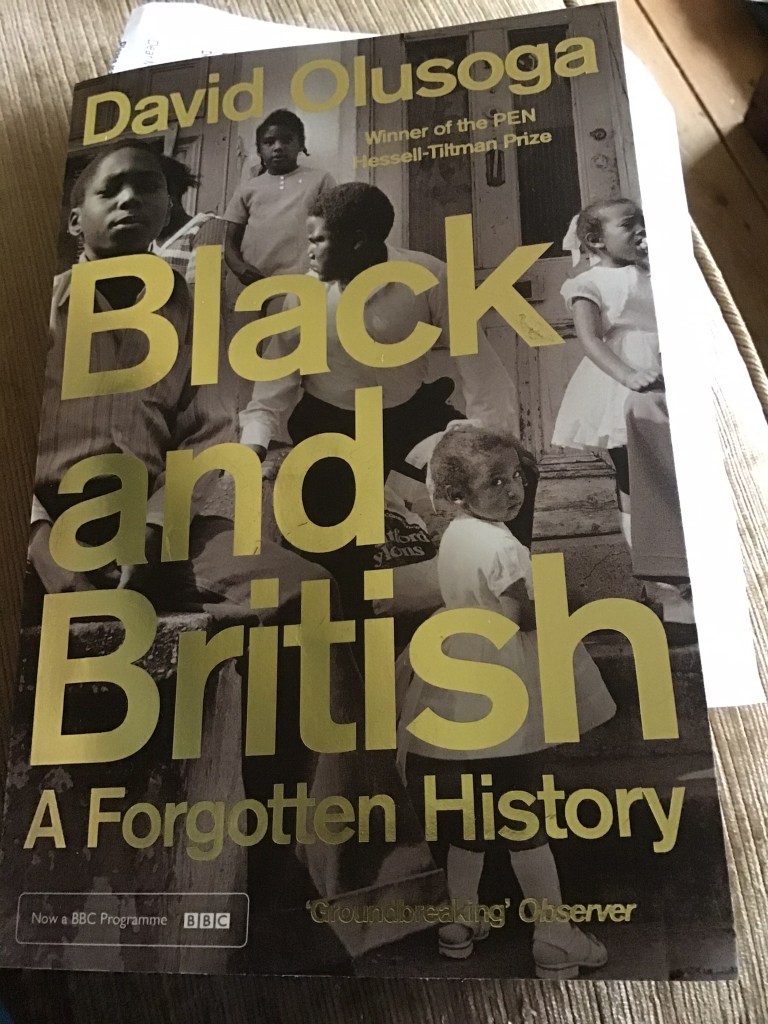
Those of you who have been following my hopefully endearingly shambolic adventures into YouTube &/or the universe of books will know that I have fallen, of late, into what I might ill-advisedly call a theme: that of race, or racism. I have recently done ‘reviews’ of Reni Eddo-Lodge’s “Why I’m No Longer Talking…” as well as Layla F Saad’s “Me and White Supremacy” and now I’m into David Olusoga’s excellent contribution, “Black and British – A Forgotten History”.

This is not to say that I’m entirely lumping them together as a single subject – that would be offensively crass, right? – but there are unarguably significant crossovers between the three books and therefore it feels reasonable (enough) to gather them in for some reflection. Having said that, I’m only posting the “Black and British” review here; if you want the rest go find my #YouTube channel or delve deeper into earlier posts on this platform.

It was a specific, particularly deep conversation around the ideas of radicalism and liberalism/illiberalism which sparked off this blog, mind, prompting the foolishly urgent need to de-clutter my own head of this, if I may?

I know, I know. I should stop doing this Under-rehearsed Brain-dump Thing; it’s indulgent and inevitably error-prone. But I don’t mind risking embarrassment or worse and frankly it feels more honest to be flailing around with the possibility for self-exposure adding a little edge to the proceedings. And this fear of saying the wrong thing seems especially pertinent, here.

I have a friend who spars with people, more often and more challengingly and with more insight than anybody else I know. He is therefore a tremendously invigorating bloke to be around. Saw him coupla days ago and because we rattled into Deep Meaningful Stuff around socialism/liberalism, campaigning/activism, Eddo-Lodge and What You Can Actually Say, this post – originally just a review of sorts of the Olusoga – is in danger of becoming a rounding-up of wider themes. With the usual apologies for the usual, unattractive stream-of-consciousness, let’s crack on.

David Olusoga I like. Great TV work plus I love his punchy, witty, take-no-shittery on the twitters. Daily if not hourly, he completely dismembers dullish white blokes who think they’re being Pretty Reasonable, Actually. Crucially, he does it with some real wit.

“Black and British – a Forgotten History” is a weighty and accomplished book, of immense scope, covering stories that the author thinks add significantly to our understanding of what it has meant and what it still means to be Black and British. I say this because it strikes me Olusoga makes great choices about what to cover and makes no bones about swerving biggish chunks of what might seem to be essential if that material is covered well or comprehensively elsewhere. So I certainly learned stuff; enlightening, revealing, fascinating, poignant stuff as it were from the fringes. Hence the subtitle “Forgotten History”.

One example: I’m not sure I knew anything about Charles Wooton, and yet you will see (if you bother to click on the video) that the story of his desperate hustle through the streets of Liverpool – so compellingly told – was absolutely central to my experience of and learning through this book. What Olusoga calls Wooton’s ‘lynching’ is both horrifying and a little familiar; the evil of murderous racism on our streets feeling uncomfortably close, to me, in this era of race-fuelled, hate-filled populism.

There is much else to say about this very fine history book but I am content enough that my flawed review grabs a hold of enough of the thing to persuade you to read it, if you haven’t. “Black and British” is simply a 9 out of 10-er; intelligent, readable and with a tremendous historical/social-political scope. Get on it.

But hey, that conversation. In a kitchen in Bristol, appropriately enough, given Olusoga’s connections to, and work within, that fascinating city. I’m with my mate, the Dangerously Brilliant Mind. (Hey if you read this, ****, forgive the intrusion(s): massively respect your intelligence, integrity and… we ‘ave a larf, too, right?)

Don’t remember what sparked off the particular line of enquiry – probably an opening exchange in which we spoke about recent reading – but we soon got into his ‘specialism’ around political/philosophical convictions.

Hilariously, on reflection, this was about 9 am on a Saturday morning, after I’d stayed over with the family. And yes we were socially distancing as far as possible.

**** is a profoundly good, honest, caring man; hard to categorise entirely, politically but certainly not a right-winger. He does, however, have an intellect which is so penetrative and well-armed with reading and with knowledge that it feels austere. (This is not a criticism: it’s an acknowledgement of his fierce brilliance – which I have said, is bloody invigorating).

He has come to identify as a liberal rather than a socialist, in part because he is appalled by narrow, clubby, deliberately intimidating politics from The Left. ****, (who is broadly lefty), thinks there is a kind of evil in the meanness and acute tribalism amongst the Activist Left, whom he would argue, seem to hate what we might call ordinary Labour supporters more than they hate Tories. In fact, maybe they hate everyone who isn’t them?

Of course this is what Tories and Centrists have typically argued so again I put on the record that neither of us fall into those categories. My Bristolian comrade feels it simply ain’t viable to support alongside or with this group – and he does support the majority of ‘Labour Causes’. In short, the illiberal nature of some ‘core lefties’ offends him.

We talk about this and I’m not disagreeing. Then, because we can get into controversial territory and ver-ry frequently do, **** (who is no racist, no right-winger, no mug) expresses concerns about some of Reni Eddo-Lodge’s contributions, in her own field of activism. Is her important work – the books, podcasts, public advocacy – nevertheless in danger of suppressing legitimate debate because by accident or design it may be closing down or narrowing viewpoints towards a kind of puritanical activism? (Should add here that a) my pal has read and listened to Eddo-Lodge and b) that both of us are fair-minded enough and wise enough to appreciate the obvious dangers, re- Middle Aged White Blokes failing to get the ironies currently circling and blowing their klaxons).

We do know that overhelmingly it’s Black Voices that are oppressed. Both of us have and do support anti-racism. And we are not so weak-minded as to be saying all activism is kinda fascistically predicated on nastiness and brutal, exclusive oppositionism; activism is necessary, is wonderful, is essential.

**** is I think merely making the argument for intelligent, humane, broadly inclusive campaigning. He makes a bold, contentious point and I have some concerns about these views but am also clear that I have felt conflicted about whether or not to Say Anything… because I’m a White Bloke!

More ironies, possibly, but I think I am on here and Youtube doing this stuff despite knowing my voice is less important, less relevant to this discussion than a black voice might be – and arguably has less rights(?) – but also because, conversely, it feels wrong to shut up for fear of committing some transgression. White Angst? You bet. But part of my real experience.

I fully understand that the last couple of paragraphs may either seem perverse, or worse; racist. I already regret that I’ve probably conflated leftiness with Black Activism; this does all of us a disservice. Maybe I will go back and edit, or maybe just re-offer the thought that this sense that something ‘illiberal’ and possibly injurious can associate itself with activism – particularly, perhaps, when there is understandably acute anger in the mix.

This has little to do with the review posted below… of a really good book which I heartily commend you all towards. My de-tour has been about how we try to oppose social and political evils – which we must, urgently, together – whilst maintaining as much of our human generosity as we can. But hey, read the books!