The more I’ve thought about the particularly rich and what we might now call developmental periods of my life the more obvious it’s become that anger and conscience sparked via music have come to guide or define who I am.
Music can describe, reflect, light up or emphatically nobble us. (Confession: I’m crocked). Very often it does capture the times themselves – the times in which we grew. Of course relating said theory to punk or new wave may seem thin to those who weren’t there or those who just don’t get shifted by choons in the way some of us have been. But surely you get this? Surely you have your own tonal moments, or words etched over your heart? Songs that just carry you, whatever the era?
Welcome to the club. Whilst I will maintain that ’76-82 was massive, not just for my gang of mates but in terms of influencing zillions of lives, I am clear your own vibe is just as valid. Tell me all about it: maybe later?
We’re bound to hype-up the things around us when our hormones are hyper-active. Things are or were more highly-coloured when we’re young. That perspective is always gonna out-biff real perspective and I’m fine with that. ‘Our music’, the stuff we got off on or got furious to in our teens and early twenties, is always gonna be the best. For me this was punk and post-punk. Yes I can take a philosophic in-breath before conceding that it’s not the Only Time. But it felt that way. Maybe until now.
Clearly and for obvious reasons, everybody holds tight to the music of their teens. I get that. It’s just natural. It’s gonna feel special. But try to get a fix on 1976/7/8/9. It feels like the streets are on fire and sometimes they are. There are Thatcherian (was that ever even a word?) or what we might nowadays term Trumpian levels of divisiveness and even hatred in the political ether. There’s Jonny Rotten and Joe Strummer and Paul Weller… and that sound.
(In my humble view) the late Seventies is the greatest time in the history of popular music. For the energy and the intent, however flawed, or obscured by inadequate explication, however feebly understood by the pogoing masses. Something was really happening. Throw in being a tumultuously hormonal young fella with a powerful sense that things aren’t right or fair, plus shock and existential confusion over a family tragedy or two. Why wouldn’t you attach, pretty directly and permanently, to the soundtrack of these life-changing moments?
But why was it so brilliant? I’m thinking because here in Blighty it kinda had to be.
The Punk Experience was all about immediacy, urgency, spittle; about kinds of revolution in the now, because of the now. In our case that meant Thatcher, injustice and anger. The North-South divide. Racism. Homophobia – later enshrined in the law in the infamous Section 28 – but a part of the Thatcherite vocab well before HIV struck in 1981. Shameless boom for some, bust for many. We can be entirely specific that Thatcherism was a signal factor in the emergence of a furious counter-culture. Trump and Musk are surely worse by every metric?
What does this mean, if anything? A) I find it fabulous, rich territory, this whole idea that powerful responses to circumstance, through art – i.e. music – can be such huge, formative participants in our lives. B) That implies (or makes un-deniable) the notion that both individuals and cultures – political, structural – can be changed by noises, by ideas. Throw in the demystification and opening-up that was essential to punk and we may have grounds for optimism that a Second Coming (for widespread, meaningful dynamic protest music) really may be a natural outcome, *here and now*.
*
Chewing this over with a mate and he offers the thought that maybe Mozart was punk: he certainly set out to provoke The Toffs. My understanding is that the great man had a love-hate relationship with his audience and that the work, beautiful and godlike though it might be, was on occasion(s) specifically driven by conscience and by anger. He was also something of a rebel entrepreneur, hosting his own gigs to make those socio-political statements. (Malcolm McLaren, eat shit!) Point taken.
Spinning forwards, it seems obvious that popular music was intrinsic to the cause and the life of the Civil Rights campaigns of the US. (I recently watched some extraordinary footage of Nina Simone at her fierce, magnificent best. It was a revelation. More on this momentarily). Blues itself may be a resistance movement that dwarfs punk in scale and richness. Some would argue that the folk scene of the Sixties was as hearty and conscious as any period.
Zooming out geographically, of course there are spectacular and seminal indigenous protest songs from the Arab Spring and from Latin-American bands raging about murder, corruption or drugs, or the stuff that felt relevant and possibly *most obscene* to them. Go find them.
Anger is an energy. I found the ‘Rolling Stone 100 Best Protest Songs of All Time’, late-on in the writing of my next book. Found it interesting… and a challenge. Not that I’m entirely shifting from my advocacy for punk – no, sir. But a(n admittedly imperfect) ‘world perspective’, over a century of angry music? Well why wouldn’t that be a challenge?
Nina Simone’s ‘Mississippi Goddamn’ is in there at number 7. (But hang on. I bet you wanna know who tops it? Sam Cooke; ‘A Change Is Gonna Come, from ’64). Back to Nina.
She pronounced herself ‘skeptical’ of protest music out of concern that it can over-simplify and therefore reduce moments of reckoning and complexity. This was before the murder of four black children in the infamous Alabama church bombing and the assassination of activist Medgar Evers, both in 1963. I imagine she just got so mad she flew into the writing of one of the most poignant and potent songs of any time. ‘Mississippi Goddamn’ first appeared on a live album and guess what? It was banned for a time, in some southern states.
Simone also covered the Billie Holliday classic ‘Strange Fruit’ and in ‘Backlash Blues’ and ‘I Wish I Knew What It Was To Be Free’ she railed brilliantly and with passion against the patent, rancid injustice of the time.
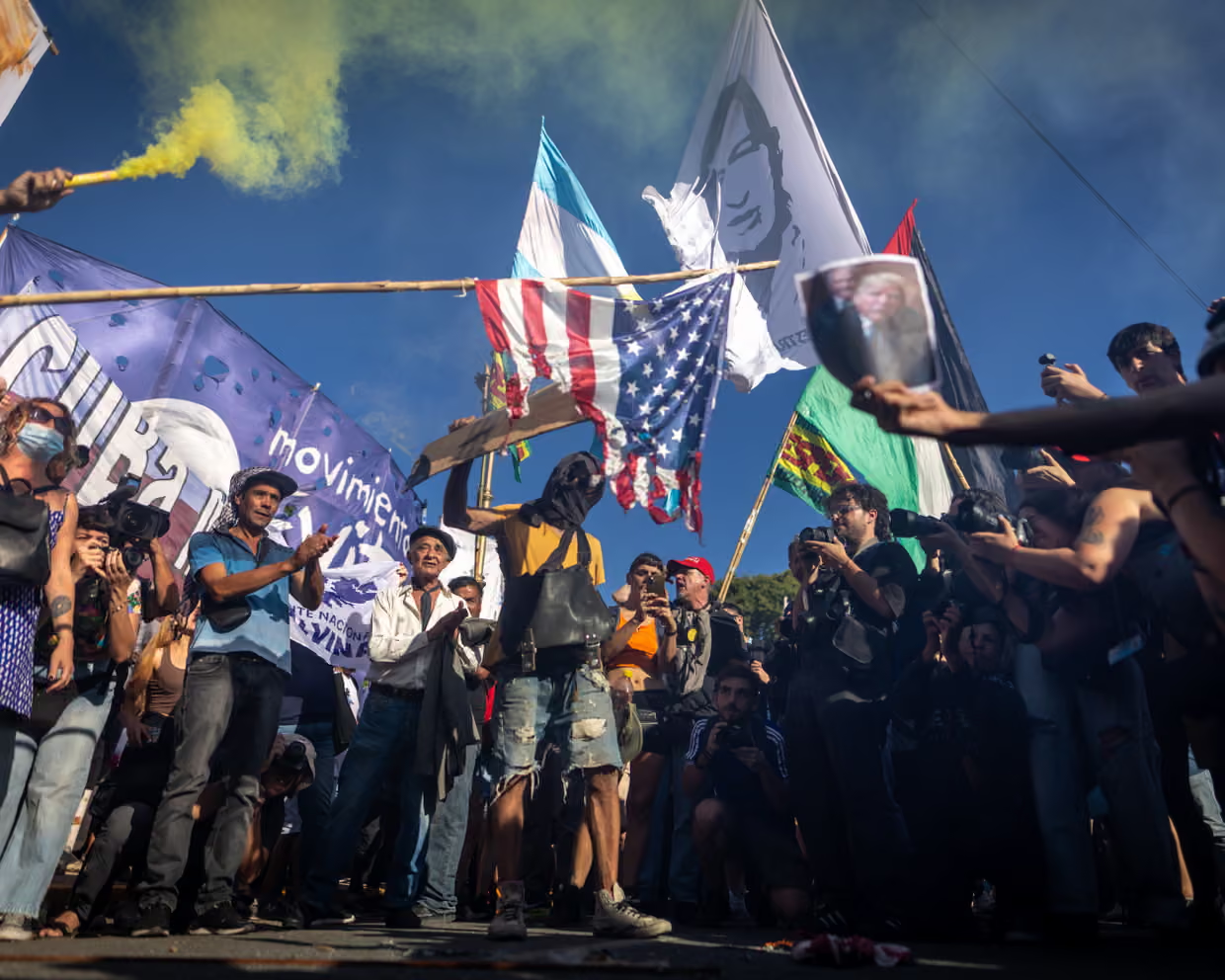
Can’t wait any longer. Who now, in the time of Musk and Trump, will carry that torch? This feels like a moment not just for Angels of Protest but for massive, concerted resistance – yes, perhaps led by artists and musicians. The wildness and vileness of the whole MAGA Project makes the bigotry and divisiveness of Thatcherism feel almost petty. I don’t normally do perspective but despite piling up a lifetime of anger and revulsion around that woman and despite being a giant pond’s distance away the pall over America feels scarily more foul than late Seventies UK.
My book is about my life and the impact upon it of contemporary rackets. I depart to major on Nina Simone for several reasons. She was radical – she told Martin Luther-King she could not be non-violent. She had a real, sensational power and talked of having no choice but to respond to the evil of the time. Simone’s voice and piano are rare, rare things. And she has produced some of the greatest music that’s ever graced this planet.
*
In that ‘100 Best’ we find Woody Guthrie – more than once, from memory – but at no. 11 with ‘This Land Is Your Land’. We find a reminder that Tracy Chapman’s smooth-but-eloquent ‘Fast Cars’ is deliciously spiky. We remember (maybe with mixed feelings?) one of the superstar protests, in ‘Sun City, by Artists Against Apartheid. We get a nudge towards checking out Beyoncé at the Superbowl – 2016, she’s done more than one! – with her black sisters wearing deliberately provocative Black Power military-chic, performing ‘Freedom’ and thereby making a HUGE POLITICAL STATEMENT IN FRONT OF HALF THE WORLD.
Closer to (my) home there is one of the most upful protest songs ever committed to vinyl – Specials AKA ‘Free Nelson Mandela’ from 1984. I played it to a theatre group in the hotel bar I was running in West Wales. Resident and rehearsing at our place, they insisted on hearing it at the end of every working day, to fire them up whilst bashing out their own inspiring art.
Number 2 on that Rolling Stone chart is ‘Fight The Power’ from Public Enemy, a raw and in-your-face revisitation to the Isley Brothers’ record of 1975. Recorded for Spike Lee’s movie ‘Do The Right Thing’, it may owe its high position in that chart to the exposure around that, as well as its punk-rap brazenness and defiance. It’s noteworthy (and I take no issue with this *whatsoever*) that all five of the chart-toppers are by people of colour protesting injustice. Suggesting again how vital a force music can be in offering an outlet, a voice that can really register.
Bob Dylan was at no. 6 with ‘Masters of War’. Interestingly – or not – the descriptive blurb alongside makes a link between folk and punk; a reminder of that profound tradition for conscious stories which is so characteristic of folk music… and, yaknow, folk like us.
Remember Helen Reddy? Me too, just about. She may be offended by the label ‘Australian soft-rocker’ but consoled by the knowledge that her ‘I am Woman’ of 1971 became a feminist icon that bounced down the years. (It’s at 73 in the chart). It kinda bounced into my lap because – I’m pret-ty certain I have this right – the England and Wales Cricket Board used the 2013 Katy Perry song ‘Roar’, which uses Reddy’s refrain, to back some All Stars promo stuff I played in schools. (I was, some of you will know, a Community Cricket Coach for many years. Am now just a Pathway Cricket Coach). In this way, Reddy’s rally may still be roaring.
The Top 100 of anything is usually reductive garbage; we know this. I take significant umbrage with the fact that ‘Guns of Brixton’ – one of The Clash’s worst songs – is in the Rolling Stone collection, at no. 56. Cobblers. Especially when I’m seeing nothing of Elvis Costello! Not going to go scouring the whole thing again but not seeing ‘Ghost Town’ (but X-ray Spex are in there) and no ‘Eton Rifles’ but ‘Fascist Groove Thang’ gets the nod. Ah well; subjectivity, eh?
*
Punk-influenced music was and is massive in the lives of many of us. It was populist, in theory and in practice, in a good way. Perhaps most satisfyingly, the advent of Independent Record Labels, or more exactly their proliferation, based and inspired around new wave music, was central to making the movement – and that whole ethos around DIY – work.
Real People could make records. To some extent the capitalist universe was successfully bypassed. Yes the treadmill was still grinding and bands were still (diabolically in my view) talking about ‘cracking America’, but the Problem of Scale – i.e. specifically aiming to make records that would be played across American radio – was suddenly drenched in righteous spittle. Tiddly, ‘cottage-industry’ Independent Labels were pumping out real and relevant music, close to home. That was important. No: it was fucking maaarvellous.
Or’nary Herberts could get up and do stuff. Me; you; Fergal Sharkey; Mark E Smith. They could record it, too, and access to new technologies would only increase, thereby (theoretically at least) multiplying the opportunities. New and often more personal or political messages could be sent out from voices previously unheard. This was the Great Demystification. The offering. You no longer had to be ‘musical’, or ambitious, or on a contract with a major. You could go from your bedroom, thrashing three angry chords, to a local boozer or small independent venue. Fair enough, this must have led to some bad art. But it gave us the 101ers and The Jam.
Values were re-set; the power of honest, simple art was re-stated; truth stood in the doorway; everybody was welcomed in.
There were a million fakers, from Billy Idol to New Romantics down the line but something did change. The mighty and sensational music produced late seventies/early eighties – Joy Division/Echo and the Bunnymen/Talking Heads and the soon come Two Tone era -could not have happened without the spark, the release, the (yes!) moral judgment and the idealism of punk. To be credible, you had to write about something. Cut the frills and the solos. Tell us what fires you up… or at least stop seeking adoration. Tell us a meaningful story. Tell us something that matters. Maybe get angry with the government.

 bowlingatvincent