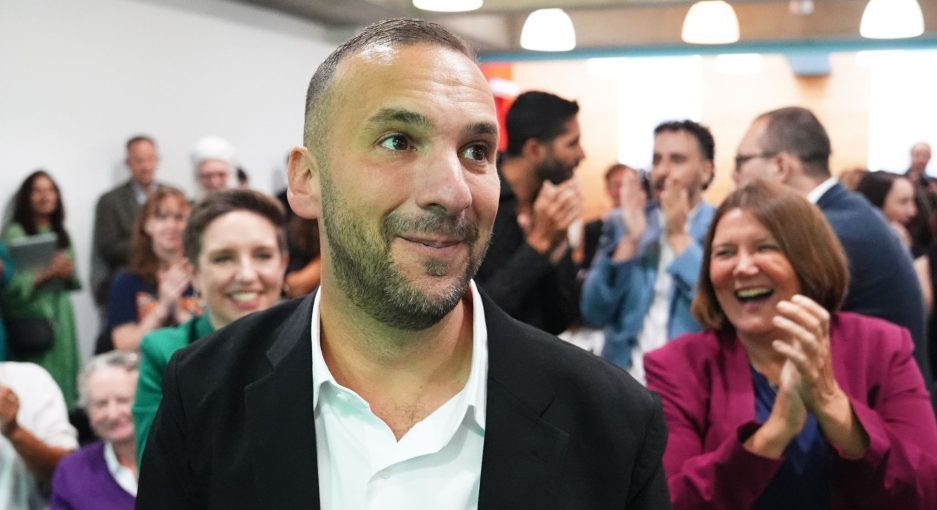
That’s why we love him.

I’m still plenty daft enough to not want to know what my birthday treat is. (Not that I get loads, to be honest). So when the ‘kids’ – my wunnerful offspring, aged 21 and 25 – tell me firstly to keep Weekend X free and then ‘get my ass to London’, I do, after a week of supporting my somewhat ailing mum, Up North. There’s nearly an accommodation trauma (none of us are quite in the position to book hotels) but in fact this works out fabulously: we can stay at one of my soul-bro’s, in Walthamstow. We arrive Friday.

We do stuff; lots of walking around both locally and in the city proper. Riverside, Spitalfields, coupla bars – all that. No hints dropped *at all* and none asked for… until I hear it’s a Sunday morning do.

Oh. So not the Cure or Bunnymen gig I had maybe posted highish on the list of possibles. Sunday morning? Outdoors, I wonder? But again don’t ask. I settle into just enjoying the friends-and-family thing, with maybe just the thought that Somerset House, for a wildish and medium-dangerous dollop of skating might be where we’re headed. (We went about 15 years ago and we’ve been skating in Spain (weirdly) and Finland (I think), so the kids know I’m mad for it). That would be fun – and kinda suitably silly for a juvenile delinquent like my good self.

But no. We’re on the tube and daughter reads out part of an incoming message. With details. Wow. I learn we’re off to the Van Gogh, at the National Gallery. Oof. That’s BIG.

Another great friend, ‘knowing I like me art’ has very kindly used her membership to get us in. 9.45, Sunday morning. We fill out Saturday with more yomping and gawping and then drop into the Do Not Adjust Your Set-ville that is ‘God’s Own Junkyard’, in a spectacularly unassuming mini-industrial estate in Walthamstow, for just a couple of gobstruck sherberts. (It’s wild; it’s neon; it’s a mad treat). Then we have to be up, early-doors.

Regular readers will know I am a clown… but I do like my art. I’m both dumb and serious over that. My general punkiness means that I can’t stand the pretence and the exclusivity that separates too much art from us Normal Guys ‘ n Gals, but I have been known to attend galleries and even read – like, choose to read – cosmically deep and dense stuff about art theory and history. I find it tough, but cleansing – yup – and inspiring.

I can’t help but be drawn to relatively modern art – say from 1870-odd forwards – and this may be because I’m suspicious of allegory and pomp, finding it easier to identify with things beyond or closer than that whole history-painting malarkey. And I should say that despite being conflicted in the modern, Guardian-reading way about the Industry that is Van Gogh, I have loved the boy Vinny for decades.

So wow. Being a resident of faaar West Wales, I may have been distantly aware of the ‘exhibition of the century’ up The Smoke. Maybe. But, being privileged in so many other respects, we pseudo-taffs let these things go easily enough. It’s that other world. We only go there rarely: until we’re there, walking to Walthamstow Central; then Victoria-lining(?) it to within a coupla stops and Bakerloo-ing it the rest. Blimey. Trafalgar Square… and not many pigeons! Ten minutes early so the daughter needs a coffee. Pret, just on the corner. Then meet J and son C and in.

I did cheat the night before and have a look. But skimmed, so as not to know which of the truly big-hitters were on show. Logged that it was called ‘Poets and Lovers’: not much more.

I’d forgotten what a building this was. Like a roman town, or an empire, or some appalling/wonderful stately home. Bloody enormous – but we’re in. Inevitably, we get a strong full-frontal at the gift shop as we spin off into the gallery. It’s quiet: not for long, but it’s quiet. The ceiling is eight miles high and the space is open; until your eyes begin to train in. Ok. There are just the three paintings, here in Room 1. Do I read the bumpf? Sometimes it’s good, sometimes it’s crap. This is good. I’m going to use it to cut to the quick.

‘The careful planning behind Van Gogh’s art extended to creating works in groups or series, and to thinking about how these might be displayed both at his home in Arles and for exhibition in Paris. By gathering a selection of these paintings – many of which are amongst his most famous and beloved creations – and showing them alongside his carefully developed works on paper, a less familiar Van Gogh emerges; an intellectual artist of lucid intention, deliberation and great ambition’.

The lover and the poet are both in Room 1; Lieutenant Millier and Eugene Boch respectively. Between them is ‘The Poet’s Garden’, all from Arles, 1888. I’m familiar with the two portraits, as many would be. Again the wall-verbals are helpful, pointing us at what may be the central revelation (or re-affirmation) around knowledge, planning, licence, intention. These are wonderful, expressive, thrillingly ambitious symbols. Do not underestimate this man – even in the loving of his work. We are already being pointed towards the idea that despite being bi-polar/’mad’/intermittently stricken, Van Gogh was a supremely intelligent man, making brilliant, outrageous choices.

‘Boch was ideal as he had a narrow face that reminded him of the thirteenth-century poet Dante. The deep blue sky (was) intended to express a man who dreams great dreams, was essential to the symbolism of the work’.

There is knowledge here: there are things by design. This is not a loony.

Room 2 contains 17 works on the theme of ‘The Garden: Poetic Interpretations’. These include several that most of us will not have seen. (One of the glories – yes, bugger it, I WILL use that word! – of this exhibition is that the mighty National, with its world-level clout, has gathered paintings and drawings that may never be seen together again. It’s BIG; it’s astonishing; it’s expansive in a way that’s supposed to be kinda thrilling – and it is). There are inks and chalks and graphites alongside the great, gripping, three-dimensional oils, here, depicting gardens in Arles, close to Yellow House and at the asylum at Saint-Remy. Some of the oils are staggeringly loaded. (One or two *really did* anticipate Jackson Pollock for me, in their lush execution). You will need to walk in and out, to feel that texture and then ‘take in the view’.

There is melancholy, both symbolized – for example by the ‘sawn-off tree – and real and felt, through both the rhythm and energy of the pieces and through our basket of knowledge. But again and again we may note what we might rather stiffly call the technical choices amongst and arguably under-pinning the undeniable and radical creativity.

Van Gogh, in a letter to Emile Bernard, describes the sawn-off pine as ‘a dark giant – like a proud man brought low’. The accompanying notes add that he ‘detailed how he combined composition, colour and technique to convey the anxiety felt by his fellow patients at the hospital’. Things are stylised or exaggerated or invented in order to serve the academic(?)/poetic(?)/artistic intention. This is intelligent work; during or adjacent to a period of powerful turmoil.

Room 3 is dripping wonderfully with icons. We are in the Yellow House, which has been conceived in order to host certain paintings in certain places. Sure the overall intention (and here lies much of the tragedy, yes?) was to welcome and impress Gauguin, Bernard or the other painters Vincent hoped to bring to the South. ‘Van Gogh’s Chair’, ‘Starry Night over the Rhone’ and ‘The Sower’ are side by side on the same wall. They are show-stopping, of course. All are moments: ‘Starry Night’ for its beautiful, rich depth (in so-o many senses) and ‘The Sower’ for its almost shocking design – part Japonais, part colour-field.

But it goes on. ‘The Yellow House’, ‘The Bedroom’ and *that* ‘Self-Portrait’. Staggering vibrancy, simplicity and earth-shifting heft. And probably driven, essentially, by that desire to furnish the gaff with homely and appropriate pictures! Box ticked.

Room 4 features ‘Montmajour: A Series’. Done in pen or quill or with chalk, on paper (or wove or buff paper, whatever they are), these mark the artist’s fascination for the locality. The moody higher ground and ruins of the abbey stirred something, perhaps with that rich vein of landscape and history and spirituality? Whatever, Van Gogh returned many times to make strikingly different works, some alluding to Zola, some obviously redolent of Japanese art – particularly woodblock printing. But is it just me, or there a sort of equanimity about what’s going on, (in this room), at this moment? (We are still in 1888).

With Room 5 we are back with the theme of ‘Decoration’. And therefore to the idea that Vincent planned – in particular in relation to the Yellow House – but also with regard to how his art should be displayed and seen in Paris. (So more tragedy at the margins). We see two ‘Sunflowers’ pictures flanking ‘La Berceuse’, as Van Gogh intended them to be shown. If we are not blown away enough by that, we can gawp with the specifically poignant wonder that perhaps this artist alone can trigger at paintings such as ‘Portrait of a Peasant’, ‘Oleanders’ or even ‘Still Life with Coffee Pot’, none of which are sad or traumatising per se, but all of which either sink or lift us to a place where a kind of impassioned humility seems in order. Such incredible beauty! The man’s a god.

We see the final chunk of our art – paintings 47-61 (and one pencil/brown ink) – in Room 6. Again there are big-hitters (‘The Arlesienne’ x 2 and a ‘Wheatfield, with Cypresses’) plus a pleasing or revelatory bundle of lesser-known works. (Happy to repeat that this is one of the joys of this National experience). We are reminded – and I may be one who needed this – that not everything was painted outdoors. Indeed the ‘retreat’ into the studio(s), for whatever reason, may well have facilitated bolder choices – in some cases more stylised ones. The notes speak off ‘calligraphic strokes’ and ‘imagined figures’. The artist is taking diabolical liberties, editing, inventing. Meaning supremely conscious choices.

I came away from this sensational exhibition feeling tired, privileged, happy. I also felt strongly that we should be nudging the Van Gogh-ometer yet further from the dominating talk of breakdown and lunacy. This event speaks, skilfully and deliberately, to his intelligence. He may be the most intelligent human (and artist) that ever lived. Maybe that’s why we love him?

Karl Ove and me.

The boy Knaussgaard definitely dun gud.

Have battered my way through the first two volumes of ‘My Struggle’, where he shreds and re-builds most concepts of art, truth, the human condition and that which is sayable. The word ‘compelling’ appears on both sleeves: it’s a word that might sound bland. Not here. I read these bad boys in a couple of days flat; almost impossible not to.

‘A Death in the Family’ and ‘A Man in Love’ are MASSIVE LITERATURE in the (classic?) sense of having tremendous envisioning scope, and also in terms of being unequivocally serious art. The clues are in the names – most obviously in ‘My Struggle’, which is of course a deliberately epic-sounding moniker designed to bounce through the generations. This is art with ambition (as well as scary North European normalcy), aimed at the peak, at the heart, at the authentically high and thoughtful but delivered via the contemporary and the everyday. As I say, I’ve devoured both tomes.

Now like every other schmuck doodler, and despite just diving in and never over-thinking, I’ve latched onto coupla things. Notably the fearlessness and the voice.

Knaussgaard is relentless and ruthless around honesty. This is his voice and we are compelled to believe it, for the execution, for sure – for its brilliance – but also the amorphous power, the urgency across the text. Something in the vividness and energy of the storytelling (is that what it is?) completely captures us.

His often challenging but crystalline worldview(s) will out, if you will, because he commits utterly and directly: meaning the kind of autobiography that smacks you in the face because of its combination of insight and what we might call observational truth. The fella is, as Geir remarks, an ascetic. He makes a brutally real record of things but also, critically reveals the soul – in the landscape, of the people. This is some achievement.

I have read nothing about Knaussgaard, deliberately, so far. I imagine his saying of the unsayable, for example, around caesarian births and the general liberalisation/’feminisation’ of cultures and the contempt in which he holds the Swedish worthie-intelligentsia fashionista-crew draws a heavy dollop of flak.

Maybe it’s too blokey – reactionary, even? I’m watching this… but currently in the These Are Important Issues We Must Be Able to Talk About camp. Plus he is of course right about the smugness of some of us liberals. And Knaussgaard is *at least* as excoriatingly critical of himself as of anybody else. The books are alive with opinion but too wise, I think, to document arrogance or certainty. He is observing meticulously and with vigour so as to find truth: at whatever cost.

On pages 496/7 of ‘A Man in Love’ the (ahem) *wild, hard-drinking Norwegian* writes about writing itself.

(*Absolutely in as a wind-up!* Wonder if the magazine interviews he so detests have ever described him that way?!? Anyway, onwards)…

I had increasingly lost faith in literature. I read and thought this is something someone has made up.

… the nucleus of all this fiction, whether true or not, was verisimilitude and the distance it held to reality was constant. In other words it was the same.

Knaussgaard goes on to say that he hated this sameness with ‘every fibre of his being’, because it had ‘no value’. I take this to mean that he felt it an inadequacy, a distraction, a betrayal, because art should or can offer more than this. (And Knaussgaard is unmistakably a serious artist).

I couldn’t write like this, it wouldn’t work… Fictional writing has no value, documentary narrative has no value.

Value lies in ‘diaries and essays… (which) just consisted of a voice, the voice of your own personality, a life, a gaze you could meet’.

He is talking about the direct way into truth that autobiography can proffer.

Now I am not a great writer – unlike my Norwegian brother, here. And I really don’t overthink these things: I just do. However forgive me if I did feel just a teeny bit vindicated by this argument for honesty-through-voice.

By accident this is how I’ve practised my own prattling for aeons. For always. Falling back on personal experience – the things I know and care about – because that way I might find some truth. Because I would know it was honest.

That’s as close as I get or as deep as I get into thinking about what I can or should write. Bottom line, do I know it? Can I be true? If so, all else is superfluous. Number of readers, quality of reaction, fear of judgement, all an irrelevance. I can absolutely park that suspicion that I may be a nobody and a laughing-stock as long as the voice in there feels authentically like mine. I can have some hope that things on the page, feeling genuine, can resonate, can have value.

Might sound ridiculous. To hear me paralleling-along with a properly magnificent tome (or six). But I have no delusions of grandeur, here. Neither does Karl Ove, although he plainly does have Literary Ambition. It’s just gratifying (is that too much?) to find that we share the wee recognition that maybe there IS something good about writing what you really know… in your own voice.

Postscript: in a not unrelated burst of wild confidence, Yours F Truly has landed on the notion that my vicarious upgrade via the Knaussgaard voice-authentification-assessment means I am well within my rights to claim that the Dots Will Not Be Joined/Beautiful Games constitutes a new art form, which I am happy to christen lolsobiography. I trust no explanation is necessary? The third volume in the series (of however many) is underway.

You have been warned.

Beyond the budget.

(A prologue – not by way of apology but certainly to note the significant and progressive nature of the Reeves budget. Adults are in the room: some congratulations may be in order. However, I stand by what follows)…

Many of us fail to (ahem) network or even accept capitalism(?)/business/the ‘run-of-the-mill’* as a way or The Way because we don’t accept its values. It’s crap; it’s low; it’s a signal underachievement given how brilliant and generous and intelligent people can be.

*(Great phrase, by the way!)

Why would we pretend that systems designed to keep certain wealthy people wealthy and beyond accountability are satisfactory? Why would we accept them? We’re better than that.

Why are there billionaires (and why are most of them vile humans?) when most people have little or nothing by comparison? It’s not right. Why is so little of what we might call politics about redressing these obscene imbalances? (We know why: because most politicians lack the courage or decency or heart to make change and the media universe is nobbled – crippled with corruption and dictatorial myopia – by those billionaires and/or ‘media barons’ effectively corralling or twisting our views towards their own).

This may all boil down to privilege and the protection of privilege. And that may be why I have an issue with private schooling – the Industry of Privilege.

Sure there are wunnerful people – kids/families/teachers – at private schools (I know there are, I’ve met plenty of them) but they all need to be big enough to accept that they are buying or serving privilege. There can be no meaningful change – no ‘re-distribution’, no ‘levelling’ – without this first building block being hauled out, or at least called out. That is, discussed as a real thing.

The assumptions of entitlement – in the ether, in fact – start and are cultivated here. They finish, maybe, they reach their catastrophic low-point with Alexander Boris de Pfeffel Johnson and his ilk. How can this world (our world, Blighty) have come to be designed so that a human so grotesque and unworthy in every respect could make good on his wild, childhood intention of being Universe-King (or whatever the feck it was?) Johnson was and is a kind of icon to our system failure. It’s utterly obscene that an arse of his scale could believe and then absolutely find that everything and everybody really would fall in behind his boorish megalomania. Because of family and money and Eton and yup, everything.

In this landscape a budget from a centre-right Labour regime which has eminently capable but some might argue pitifully conciliatory people at the helm is likely to be an irrelevance: relatively. There may be encouraging splashing of the pool but there is already too much invested in  the appeasement of the World Order – from issues of class to the markets, to the media, to Israel, to That Which Is Thinkable – that we know Starmer and Reeve ain’t gonna stir things too much. The leadership is largely of this place; or content with it. There is no anger and no compelling sense of mission – though they talk of little else.

The party has already fallen into the trap of silencing dissenters. However much talk we hear about ‘changes of direction’, The Radical is very much out.

Sadly both this fact and the (less heinous than the Tories but still hugely galling) evidence of ‘successful’ gifting and lobbying feeds into the painful narrative that ‘them fookin’ politicians are all the same’. Plainly they’re not, but who can blame Dave from Wythenshawe for equating hugely trumpeted Labour indiscretions with heavily obscured Tory filth? With media and social media often acting deliberately against truth, how are we to engage intelligently with anything?

I won’t watch the budget coverage because it bores me and I don’t expect it to offer much of a lift. Plus the coverage will be depressingly dim. I do hope they prove me wrong and that there are some brilliant ideas – the Labour hierarchy, unlike the previous clowns, is quite possibly capable of that. Mainly though, it will tinker when we need to rip it up..

Mega.

So the Make M U Great Again campaign can finally re-boot. Ar Erik is down the road.

Be honest, he should have gone more than a year ago – yes, a year! – because despite our civilising instinct towards giving a Good Man time, he has looked weak and woeful for an age.

Not his fault, entirely, that half of his players have let this once-mighty club down, or that Old Trafford itself is a whole lot less appetising, as a prospect, than it was ten years ago, but Ten Hag is complicit in that. The team has been a million miles off being competitive for United-level competitions for several seasons. Great players – some known, some not – must surely have turned down the (ahem) opportunity to go red, throughout that sorry period. At no stage has Ten Hag made a sustained case for meaningful improvement.

I have had sympathy for the fella. Bright, decent individual, or so it would seem, with an appropriate level of knowledge. Would interview well in the corporate environment- like so many. (And of course this is The or A Problem).

Making the right noises before a panel of impressionable, largely non-football people accounts for many of the new breed of sophisticates and tactical wizards now ensconced in the Prem. (And no, this is not at all a xenophobic argument). Us Footie Peeps know (because we feel it in our guts) who has the wherewithal to *actually manage* the #legends at Top Club A or B – particularly where languor or confidence-deficiency has set in.

It was clear within about twelve milliseconds that a) United needed a strongman – because of the existential and historical/emotional drift – and b) Ten Hag was not that guy. He could not capture or successfully cull. He could not meaningfully inspire, because he is not a man to follow. He could not ‘get top side’. In another environment, it might work. At Utd, no.

Sancho. Antony, Garnacho, Amad. Zirkzee, Hojlund, Rashford. Every one of them a notch down; either too weak or too wasteful or too needy to contribute consistently to the required standard. All of them in their admittedly different ways crying out for good management. (Meaning they either need a relentless, life-changing bollocking or sustained, committed, authentic support). Ten Hag could execute neither. He chose badly, failed to lead and/or failed to find the blend. From early in his tenure all this was obvious (to Football People).

Sancho is A Talent- quite probably of the classically arrogant and delusional about his own importance sub-type. His habits may have been bad. It took a lifetime for his soap opera to be concluded. Ditto the intermittently fabulous Rashford. An uneasy non-peaceful fug settled over that relationship, too – it goes on, when it should have been managed: resolved. Ten Hag sorted virtually nothing, when United needed either a big-hearted (Klopp-like?) force of nature or a fekking dictator. In consequence there has been no spirit – let alone Spirit of United. There has been no team pattern. There has been no grit.

Players are significantly culpable. Too many look and play like seventeen year-olds. Some – like Bruno – bring the required effort but cannot find a pass. Others are one-paced or far too lazy to close down sharply or track back with commitment. United are a pale shadow; have been for years. In virtually every way you can name, in every area of the park, they have been embarrassingly short and shockingly easy to play against.

Players culpable yes, but it’s up to the gaffer to build a resilient squad and demand or drive for elite quality and performance. Ten Hag may have found it impossible to attract (or drag) the very best players to Old Trafford since his appointment in April 2022 but he’s had enough moolah and still I think enough clout to assemble a strongish posse. Instead he has a pretty sorry mix. Maguire and Evans *playing together* in key matches? Zirkzee or Hojlund as your Main Striker? Van Nistelrooy they ain’t.

Manchester United have looked and played like a mid-table team for far too long. Accepted, some of that precipitous decline pre-dates the Dutchman’s arrival but he has patently lacked the authority or heft as a human animal to even begin to turn things around. Most onlookers feel most United players are waaay down on the quality and intensity that even their rivals understand as authentically M U.

Whilst having a wee dollop of sympathy for a man who has been serially let down by his charges, it’s surely widely recognised that Ten Hag had to go? (My regular reader will know I’ve been saying that for aeons). There was some almost inevitable prevarication post the arrival of the New Upstairs Regime but now we’re done. Out. Van Nistelrooy may have a chance: rather him than Southgate, for me. Let’s see.

The ground is shifting.

Life’s busy, eh? Sometimes so busy that the MASSIVE ISSUES that sprung up either through SENSATIONAL BOOKS or profound, deep conversations have just wafted around in the ether like smoke – or like smoke that teases, or threatens to draw you in – rather than being ‘addressed’. (Whatever that means). I kinda like that life can be chock-full of undeniably seminal stuff that somehow contrives to drop down low, low in the list of priorities because the allegedly everyday swamps it. That’s both appalling and charming somehow, right? Can’t sort out the meaning of such-and-such, despite it’s marvellous heft because the bed-linen needs sorting, or the ailing dog just may need checking on, or the team for Sunday needs bunging up on the Whatsapp. Hang on: what about the revelatory import of that, or the mind-boggling measure of this?

I need to be specific but that may also undermine the very abstract (or abstracted?) nature of the mad-wonderness of what goes on. Let’s start with a book, briefly.

Top Raging Intellect and buddy of mine points me at ‘A Death in the Family’, Knaussgaard. My own family baggage may be in play but wow what a blast (of something, of everything) that was! Traumatically compelling but also deeply fortifying; probably on account of the undeniable brilliance *of the writing*, (whatever that means). Dark and deeeep and relentless but also pulling us through, yes? To a place where we are enriched, despite being bloody and exhausted, probably having devoured the 400 pages in the minimum possible time-frame. Emerging to nearly think excoriatingly deeply about x or y, but then yaknow, the washing got in the way.

But great book: surely, truly a great book? May go at it again within a day or two; domestic shite permitting.

So there was that, impinging deeply and then not, and there was also sporty stuff – there always is.

Look we need to light a fire under the loony impostor that is X; we know that. But I’ve always maintained that the Twitters can be tremendously uplifting (and even civilising) because if you offer good energy and make intelligent choices then fabulous, interesting people reveal themselves to you. Amongst the absolute donkeys. That happened again.

Cycling. Tour then Vuelta. Immersed and also dipping in there. Love the wild scenery, the filmic drama, the bewildering strategising, the ridicu-effort. Almost yearn (if that’s a thing) for untramelled belief in the sport of it – the who won, the who dug impossibly deep and found something special. But the buts are big, yes?

I’m not close to this – meaning I’m not even a club-level rider – so *being sure* has been at issue. For years. Watching Roglic and Evenepoel and Pogacar and Vingegaard perform to a superhuman level and wondering. Being unable to trust it, despite a lifetime of loving and believing in sport – despite being culturally behind the power of spinning legs and bursting hearts. Godammit. Feel the effort, here. Can we not just ignore that doubt? Just pretend?

Nope. Not after reading ‘The Art of Cycling’ and exchanging tweets (I know, I know!!) with James Hibbard, author and philosopher and (oh), former elite-level cyclist.

*Inserts: the bloke’s prob’ly getting some zeds in CaliforNIAAY as I write. I’ve messaged him to see how comfortable he might be with being outed as an authority and Man of Ideas around this. Typically I’m blasting on regardless before hearing back*. (Later heard back. he’s cool with this).

Firstly I loved Jimmy Lad’s book. Strongly recommend to anybody with an interest in thinking, never mind cycling/philosophy/psychology/soulfulness/ethics and the other wee corners of humanity that the fella digs into. Secondly, the twittering.

Muskrat’s enclave is still a place where decent people can quietly revolt… by exchanging perdy decent ideas in an agreeable way. By discoursing. We did that and I learned. (For fairness and to avoid litigation – lols – let me say here that not all of the following arose from conversations with James. But some new knowledge certainly did: and some of the rest was extrapolated out, or results from Yours F Truly stretching his cranial wotsits or curiosity towards other sources). It’s been good… and challenging… and may not have unmuddied the waters entirely. But healthy. On.

James was a pro rider and on the US track cycling team, back in the days when (says he as if those days are over) use of EPO and/or similar was widespread. Hibbard, alongside Paul Kimmage went public with fears and truths that remain relevant – not just in theoretical/moral/ethical terms but in relation to how cycling actually is now. In short, JH is clear that recent performances by leading riders have been ‘physiologically impossible’ without doping. He is similarly clear, much to our mutual regret, that the culture of lying persists. Cycling is still not just unclean but brazen. Hibbard argues that because this has gone on for decades – anti-doping technology (or will to prosecute?) being so-o far behind the use and masking of performance enhancement – that the whole eco-system is damaged. Specifically, there is no way that young riders entering the elite arena can expect to remain clean and succeed. (Or vice-versa).

Having read ‘The Art of Cycling’, I am in no doubt that Hibbard is a good man: a student of philosophy; a Proper Athlete and a man of reason. His arguments are compelling – even when they run on towards solutions that he himself admits are challenging. There’s a danger when reducing BIG ARGUMENTS but he is on record as saying that because the generational culture of deceit has been so meretricious, so tawdry and so subversive of all sporting values, we may need to re-set, to get real. Whilst it may feel better and maybe more comforting to up the ante (yet again) on prevention, this is simply not gonna work. So maybe (yes, with a heavy heart) opt for what Hibbard calls an F1-style regulated environment, where doping is tolerated and monitored – in order to keep athletes safe.

Your distaste for this may be the same as mine was. But cop this:

I think the interesting part is just how to go about making sports as beautiful and culturally useful as possible for young athletes.

(This from a message, on the Twitters).

In other words, we are both power-of-sport lovers and romantics: not guys looking to capitulate around our defence of ‘purity’. Hibbard is reluctantly driven there because the reality is so poisoned and the remedies will be corrupted in the same old ways of old. The tradition for what us Brits call diabolical porkies runs too strong, is too resistant to our goddam decency.

Look. The Vuelta and the Tour de France are getting bigger in every sense. Stages are massive and arguably more painful – what with monumental distances and intermediate sprints etc etc. The window of possibility for clean sport is closing as the conspiracy gets deeper and darker and more relentlessly obdurate. We’re all already perverted. To move on, we may need to think the unthinkable – or just do it.

Hibbard again:

I think I weigh the harms like this: sport as an F1 like operation with an athlete and responsible medical staff is not ideal, but athletes/teams doing all of it in dangerous ways to avoid detection with poor psychological consequences for both PED users and clean riders is worse.

Finally, zoom out, because we’re not just talking about cycling here. Other sports have dopers. What about this idea that we the sentient universe *actually might* host a kind of enhanced games, where events are open to performance-enhanced athletes? (Blimey: another worrying lurch on the god-forbid-ometer, surely? Automatic recoil mode engaged). And yet, if medically overseen, is this not where we’re moving – or being shifted?

I’m just about the daftest sports-romantic I know. But I hear the arguments.

The personal and the possible.

The personal stuff. A Tory-free Wales. Pembrokeshire red. (Grimsby red, too!) Feels almost great.

Deeply pleased that not just my own former MP – Crabb, Pembs – but every Conservative clown or thug or xenophobe has been cleared-out, from Haverfordwest to Harlech. This is a triumph, of sorts.

Watched Neil Kinnock on the tellybox, last night. Really interesting. For one thing he was beautifully and next-level articulate: he was also bold and honest enough to target the appalling behaviours he views as being central to the debacle. Nellie bach nailed the badness of the central characters, without needing to name Johnson and Braverman and Truss. We all know what kind of people they are. Kinnock described the ‘revulsion’ we feel for their entitlement, their mendacity, their cheap and shameless waving of that race-card as a symbol of electable(?) single-policy hatred. Good, finally, to hear a prominent Labour figure express the obvious: that policies matter but so does decency – so do morals. We can be better than that.

Strangely now, (or maybe not?), I’ve heard Conservatives finally and belatedly call this out, too. George Osborne had moments of clarity and decency, during last night’s coverage. As did Buckland, this morning. They both directly addressed the sleazy-shiftiness, the shittiness, the behaviours that characterised Johnson-ism and its corrupted hinterland. So if we get into reasons for the Tory wipeout, for the scuppering of twelve Conservative Ministers, for the quiet, seamless ushering-in of the Low-thrumming Starmer Machine, we maybe can or should park political ideologies… and look at urges and feelings.

Cannot stand Farge and deeply resent the platform offered to him. Would go so far as to say that I hold the BBC partly responsible for Brexit, on account of the ridicu-level of airtime the boorish dunderhead received – chiefly, of course, on Newsnight. That airtime felt suspicious to the point of being corrupt. (Oof. That word again). The media generally have been heavily guilty of making Farage the story and thereby changing the story. Extraordinarily, editors have baulked at challenging the wrongness and badness at the heart of his ‘schtick’: instead they have courted and thereby encouraged racism in the ether. This has been a signature disgrace.

Wales has a concerning number of crass right-wing citizens – hang on, let’s call them what they are; racists – so following the vote-counts the story here has already been twisted towards ‘Reform Success’. That’s the headline: not the fact that there will be no Reform MP’s within Wales. Similarly, there is and will be a disproportionate dollop of coverage across the nations. It will be noted that folks have voted ‘in protest’ at the government’s manifest failures. They’ve ‘struck out in anger’, (bless ’em).

The fact (and it is surely a fact?) that the overwhelming number of Reform ‘supporters’ are dumb, effectively apolitical xenophobes-plus will continue to stew but remain unsayable. This is problematic territory: people have the right to protest but racism (and the advancement of what we euphemistically label ‘populist policies’) is and are stupid and wrongheaded. In fact they are just plain wrong. Wilful, negligent, cowardly or overt support or appeasement of Farage has put us here – in a place where danger lurks. The media have served us badly, again.

But hey. Reform are not the story: the Tory Wipeout is. There are no Conservative MPs in Wales. They have been decimated everywhere else. This is a profound change for the better. Starmer has steered Labour with caution but some skill. I nearly couldn’t vote for him – but did. His blandness and that whole deliberate strategic policy-vacuum-thing did my head in but worked. Retreats on green-ness and social policy are concerning; his invisibility then appeasement on Gaza was appalling. His complicity in the wretched and everlasting demonisation of Corbyn* is an embarrassment and insult to the collective intelligence. But he’s used these things (godammit) to win big.

*Where is the Corbyn victory story, in the media, by the way? Mysteriously lost)*.

There is almost no chance that even with a super-majority, Starmer will shift towards the transformational change previously aspired-to. This is another, ‘realist’-centrist new Labour. Despite using the word relentlessly, the new Prime Minister knows he can’t afford to change much – even if he had the appetite. No dosh for Big Projects; not really. But the fella is cute enough to know that decent, steady politics will douse most of the fires. There will always be racists and dumbos: we must all hope their urges can be appeased or defused by good governance and improving circumstances. Not easy; not swiftly achieved; but possible. I wish Starmer and Labour well.

pic from BBC.

‘Being clever’.

Politically, I’m soft left. This may be utterly irrelevant but I’m putting it out there as a marker, probably to establish clearish reddish water between me and the suspicion that I may be some Victorian authoritarian loony. I’m not; I’m really not.

To further this erm clarification, I’ll do my best not to drop garish giveaways like ‘behaviours’ or ‘morality’ into the upcoming diatribe. Or at least I’ll clothe them in sassy, sexed-up references to Taylor Swift’s jet(s), to rubber-stamp my down-wiv-da Street-wise Kids-ness. Coz I’m cool wiv all diss.

So anyways football. And Scotland. And ‘being clever’ – ‘using your body well’.

Scotland deservedly went out of the Euro’s last night because they been poor. Shambolic against a good Germany, ordinary but strangely spiritless against whoever-it-was, then bit more composed but still almost completely lacking in threat last night, against Hungary. Understandably (but also bit feebly, I thought) the gaffer blamed *that penalty incident*. (Come on Clarkey, your lads, despite sensational, impassioned support, barely threw a punch throughout the tournament. That’s why they’re out).

But yeh the pen. I keep finding myself writing ‘things are complex’… and they are. That penalty was all of the following, arguably, or certainly, or something:

stone dead.

Not given.

Reviewed (by a system that has put the Premier League’s notably to shame) and not given.

All about the defender’s clumsiness.

All about the Armstrong’s intention to draw the foul.

Complicated by the referee’s (and the review team’s) likely view that the attacking player did indeed set out to draw a penalty and therefore deliberately shifted his body across the defender, to draw contact.

Insert your own.

I reckon all those things are in play. So here’s my view.

I have no significant sympathy with the attacker. In fact I think it’s laughable and even embarrassing that anyone should, *as their first option*, look to draw a penalty there rather than let the ball run on and smash the fekker into the net. It’s all of cynical, feeble and fabulously emblematic of the modern game. Armstrong’s not shielding that ball – he doesn’t need to! – he’s on a greyer, less worthy mission, in a new, slick-but-twisted universe.

Strikers unworthy of the name have cultivated – and yes that does mean practising as well as drowning themselves in the mental-theoretical slurry – the anti-sport anti-art of defaulting towards fouls and pens, even when actual goal-scoring is not just the right option, but the easier option. Most fans I know think this is shit: and it is.

But it’s de rigeur, it’s everywhere – they’re all doing it. And the pundits are saying ‘it’s clever use of the body’, or ‘brilliant’. Shame on all of them for not calling it out for what it is. It’s ugly; it’s soulless; it de-values the game. These are crap, unedifying behaviours. Let’s go the whole Victorian hog – it brings football (or that sense or essence of sport) into disrepute. Football that zillions of us love. Football that those Scottish fans charged across the continent to see. And when their hearts stop raging many of them – despite the macho cobblers exchanged in the pub – will wonder out loud why their fella didnie just stick it the fuchan neyt and make the spot-kick outrage irrelevant.

Instead their sub instantaneously went for the body-shift. Instead of allowing the ball to roll across him just a wee bit. And in doing that, with the officials taking mental notes, and neutrals all screaming ‘what the feck is he doing(?!?)’, the player offered the referee and the review team the opportunity to act against him.

They may also have thought ‘WTF?’ They may have Victorian morals, who knows, and sought to strike a blow for honesty and truth. Or they may have looked hard and decided that because the attacking player obviously seeks contact and obviously moves across the defender – unnecessarily – then the defender cannot avoid the coming-together. And therefore it’s a football accident; a collision in which any guilt is more rightly apportioned to the Scotland player, not the desperate Hungarian.

Whether this is the same as calling this event the Scotland player’s fault, is a teaser, eh? (He deliberately opted for contact; he chose not to score. The ref is and isn’t penalising him, I suppose). That call is beyond the referees pay-grade, in any case; I’m just offering the thought that the officials may have judged the incident the way they did because the attacker’s cynicism(?) struck them as meaningful.

But where do the rules take us on this philosophical stuff (around striking, around decision-making, around faking)… and if it is unsatisfactory what do we do?

There’s no chance of going back to the days when strikers instinctively struck, sadly. No way that these #football #legends are going to stop exaggerating every single head contact, or slough away the modern awareness of conveniently encroaching bodies coincidental to the penalty-box. ‘Being clever’ (or cheating, your call) is with us ad infinitum and ad nauseum, surely? There is simply no appetite to clean it up or call it out. Except wiv me and my wee blog. Where I repeat: no sympathy for anyone – anyone – who transgresses against what sport is.

The Occasion.

If it’s possible to *really feel* vicarious angst then I’m in there. After the playoffs. Won’t embarrass the fella too unduly by naming him but bezzie mate’s a Leeds fan (for his sins) and season ticket-holder, so traipsed down to you-know-where, earlier.

Now it could be that my absence from the event and pseudo-concerns abart everyfink free me up to be independently irritated and disproportionate (wot, moi?) about the whole cowabunga here, but let me spill the bile. After a brilliant opening, Leeds were staggeringly bad – given this, given that.

The England-destined Gray went from being upright and assured to flopping foul-throws at a comrade four feet away. Gnonto had a 100% incompletion rate and was lucky not to be hooked at the half. Somerville disappeared; the intent/application/confidence/fluency of the whole bloody team went on holiday (or boot camp?) after about twelve minutes. Extraordinary… and yet of course not. Just to do with The Occasion. (In Leeds’ case, that may be in the plural: they’ve lost a bundle of these playoffs in succession. Is that a factor… or just a stat?)

Southampton were on the rocks for eight minutes then, without stringing four passes together for the whole match, turtled their way to the sea untroubled. Eggs laid in the form of an excellent, incisive pass/run/finish. Or maybe that should be run/pass/finish? Armstrong did his best throughout to look like a wily professional ready to escape this mediocrity: he did it really decisively once. Enough.

Farke, the Leeds gaffer must have been sick to his stomach – and the urge to barf must have built. I have no doubt his players were prepared and willing, not to say pumped, pre-game. Wembley would suit their sharp movement and threaded passes; their strike-force would dance all over this. It looked that way only cruelly briefly.

Immeasurably, bewilderingly, predictably (and all the more fascinating for it), Wembley – in fact finals all over – has/have the habit of sucking the lifeblood out of folks. Eyes glaze. Players hide or flick the ball away, wanting things to either work or just be over. Heads drop both in terms of looking, of vision and then spirit: one ridicu-fluff leads to a freakin’ epidemic. How many times did Leeds players make bad, baad choices when easy passes were on? How many times did Rodon or players who can *actually play* hustle in clumsily and gift dumb fouls? (To be fair, both sides did this: there was a constant, unedifying theme of defenders clattering through the back of receivers – under-punished).

We could lump all this stuff in under the category of ill-discipline, or maybe that of infectious nerves. For christ’s sake lads, have a think!

Wembley saps you and occasions sap you. Big tough characters become pussies, in respect of their ability to resist the capitulation to under-performance. Nonsense errors creep in. You try a worldie of a pass when the fullback has acres to storm into. You stop seeing.

This is ver-ry hard for managers to manage, during the game. Theoretically it happens before, over weeks or months – you build what you think will be an invincible culture of confidence and intelligence. Then, come the day, passes get ballooned and crosses go out for a goal kick. The Leaders and Characters in your squad turn into passengers; or wanderlings; or Lost Boys. They can’t for the life of them do the things they did last week (when thrashing oosit), or in the first ten minutes of this fekkin’ game! Gone.

(This is not the best or most obvious example but) Ampadu is a good player; offers composure and influence beyond the scope of most defensively-minded individuals in the league. Fetches and carries with confidence for Wales – is a play-maker. O-kaaay, so maybe he had a different role, today… but where was he? Who was eyeing the nearish horizon? Where were the midfield and the attack, come to that, after the fabulously misleading opening salvo? Given that Southampton offered virtually bugger all – didn’t need to – throughout, the entire event collapsed inwards with failure, folly and even embarrassment like a wedding speech gone bad. The wife’s name was mispronounced. The wrong hotel credited. The DJ cranked up Patsy Cline waaay tooo early. It was a weirdly extended howler.

Maybe I exaggerate. But fans do – even vicarious ones. For Gray to lose his laddish lustre and Somerville his tricksy genius so early and completely, hurt.

Us Victims of Football expect finals to be crap; they normally are. Maybe it’s this low expectation that exacerbates the lean into psycho-gubbins. Or maybe that’s just me?

pic from Getty images.

There is hope.

Intelligence and good faith. And decency and art – or artfulness. It can destroy evil. I believe it.

Braverman is like some icon of dumb, performative, calculated vileness. She *actually has* a brain, of course, but is so lost in poisonous ambition and that all-too-prevalent urge to penalise, to look to strike back by sticking it to The Other, that she allows herself to fall into obviously racist malice.

She’s probably coached there, by Tory shitholes – probably youngish; probably guys ‘following the ‘trends’ – who tell her that it will play well: it’s Route A for the populist. But let’s not excuse, to any degree, her responsibility and her profound immorality. She’s making choices: they stink.

(For her) to be so far from humanity and understanding must be bleak. Actively seeking the approval of the foaming gammon; courting it; stoking it. Dragging that corpse into the light. Weird and soullessly dark.

Question: is there anything lower than the deliberate, cynical exploitation of the cheapest tribal fears we can muster? Probably not. It’s all the tories have had, for years. I think even some of the divs who voted for Brexit realise that, finally. There’s just a sense that everybody knows, now, that the Conservatives aren’t just incompetent and self-serving, they’re corrupt to the core, with hatred and with greed. Even those with a low brain-cell count have ‘concerns around this’, in as much as they can process moral issues. They know, too, or sense summatz iz up.

So the tories are fucked. A series of appalling governments, with heartless and/or entitled ‘leaders’, not just physically and sociologically estranged from everyday needs but actively accumulating through the crises; busy embezzling, in effect; shameless as well as clueless. Single-message puppets for the cheapest of instincts – driven there by convenience and utter absence of goodness.

The result, a kind of vacuum – or worse, a noxious well. Into which the slimeballs and supremacists have been encouraged.

In time we will have to accommodate the Red Wallers and the Out There Racists; despite feeling that their stupidity was and is monstrous. That’s our challenge. A) To git darn off the high horse and b) to be accepting of their right to be wrong and even foul. We have to accept that many have both voted and acted out of fear and yes, ignorance – no choice, we have to make this work! – and that *even they* can and do make important contributions to family and social life. In short they have, in certain respects and areas of their lives, values and value. (We may think we know what’s right but we ain’t always poifect, eh? Move on; co-exist; make this better, in a civilised way).

Testing as this is, striking that balance between righteous and rightful action and tolerance (even) of excruciating prejudice has to be the way forward. Call it out but let the law do its job: and encourage or improve the legal process over time. All tough, all necessary.

Wonderful and revelatory as this is, it barely feeds in to my signature point: that the @MarshSongs contribution to the long and honourable line of intelligent protest is an example of the beautiful slaughter of political depravity. We need that. It restores us.

Beautifully specific and appropriate to the Moment (when Cruella B gets picked apart by glorious silence) and deliciously bang on the philosophical money, the Marsh Family undress this un-suss, unsuspecting populist clown in the same way that the silent protestors did. She gets it worse than she would in a tongue-lashing from an angry-but-righteous activist, or from someone like me, blasting away from a safe distance.

Bless those protestors and bless the Protest Singers. They keep use sane and alive.

Standards.

Here’s something: hurdles. Willow or hazel. Kindof woven fences. They’re beautiful.

Beautiful and I like them. I’ve used them many times, most often when I was a demon landscaper – actually for many years, in Pembs, in that proverbial ‘former life’ – when I was equally hopeless at sucking a meaningful living out of the earth.

They’re soft, and yet not, being literally but somehow pleasingly coarsely woven from either willow rods or cut hazel. You can buy them at fixed sizes – 6′ x 3′, maybe for hosting borders, or 6′ x 6′ if you need a standard boundary – or you can pay an extra lump and get them custom-made.

But hey they’re not standard. They’re stand-out. Cousins in General Aesthetic Improvement. The one stiffish and redoubtable (but still homely), and the other slicker and speaking more of damp and fluency and slickness.

Willow rods or withys/withies get soaked for aeons after cutting – something to do with tannins and also to extend their suppleness – and they’re often reddish-brown, drying when installed to brown/grey. Coz I’m an extravagantly gifted artiste (as you know), I worked out early doors that you can curve your structures: we made some groooovetastic garden dividers and shapers and sexy-border-backers by gently arcing hurdles. You can do it by simply driving in wooden posts and easing the hurdles into shape.

If you’re not thrillingly sculpturally-inclined like myself, you can bang em in straight: they still look great. You just need bog standard 3 or 4 inch round posts – two or three to a hurdle, depending on size and exposure to wind – a post rammer, and some wire or tie. That’s it. I’m but gobsmacked so few people use them to mark their boundaries or tart up their gardens, given their immediate and obvious wow factor.

They’re not even that expensive. Hazel hurdles, which are heavier-gauge and more robust than the willow, came to me yesterday for £80 each, all-in – so including delivery from Zummerzet (I believe. Or was it?) These were six-footers. Strong and striking and bloody good value: I put them up in less than two hours. Willow equivalents *are more*, possibly £130 a pop. But still worth it.

In that former life I was sad or fascinated enough to visit both the National Willow Collection (Long Ashton, near Brizzle) and to actively consider growing willows. I even had preliminary chinwags about using some of the National Botanic Garden for Wales’s land, to produce them. (Weirdofact no. 827: our landscaping mob did a significant bundle of work up there). I got on well with Wolfgang Bopp, then the Top Man, who was interested – liked the idea. I also tried to persuade my next-door neighbour, Robbie the Inflammable Farmer, to lease me coupla fields: neither plan came to fruition.

I just liked them – the hurdles, I mean. And the garden features and even the basketry-stuff, woven from willow. It seemed a lovely ‘cottagey’, crafty, skilful, righteous way to invest your time. But there were and are negatives.

The trips to Long Ashton and to willow growers, in Somerset, was *revealing*. I watched guys building hurdles on a ver-ry simple frame, and thought ‘blimey, we could do this’. (‘But you’d have to knock ’em out quickish, to make it at all worth your while’). I learned that (shockingly) the willows were sprayed twice weekly, in season, to knock out competing plants and munching critters. And that despite the fabulous and rich diaspora of willow species, almost the entire growing universe was down to two species of salix – maybeee even one. (It was thirty years ago but guessing the Drive Towards Progress may not have civilised this ‘culture’).

This genuinely appalled me. I thought of all the crafty people – o-kaaay, there aren’t that many but they would be exactly the type of person to be Rilly Appalled if they knew their withies had been repeatedly drenched in chemicals – and baulked. Or stalled. When it became obvious that we as a family (and a mob) couldn’t justify the likely indulgence of doing something in this apparently largely disappointingly perverse industry, and couldn’t get the land without battling scarily hard, we swerved the idea.

Wanted to use willows/grow willows. Wanted to do it organically, despite the advice and practice or state of the trade. Was gutted, in fact, that despite the seemingly wonderful tradition for family farming down there in Somerset, the reality was relatively ethically-barren, certainly in terms of chemical use and monoculture.

But hey. Bought some hazel hurdles (to replace willow) and banged them up and they look great.

Final thought: I’m aware that many of those who’ve considered investing in hurdles have been dissuaded ‘because they don’t last’. It’s true this can be at issue. But factoid no. 8 zillion and 82: ours (in a maritime location, in West Wales) lasted a decade. Why? Because we grew or transplanted bog-standard ivy against them. The ivy keeps them going – holds them – and it’s a nicer way than slopping loads of wood-preserver all over the landscape; that being the other alternative.

Hazel is a lovely beast. Yellowish and grey and soft and nutty. With added witches and buccolic wotnots. Willows are beautiful; whether weeping or just producing those erectile functions (rods) year after year, upon that cruel-but-horny autumn prune. Go out and feel them. Feel them. Or get them in your garden.